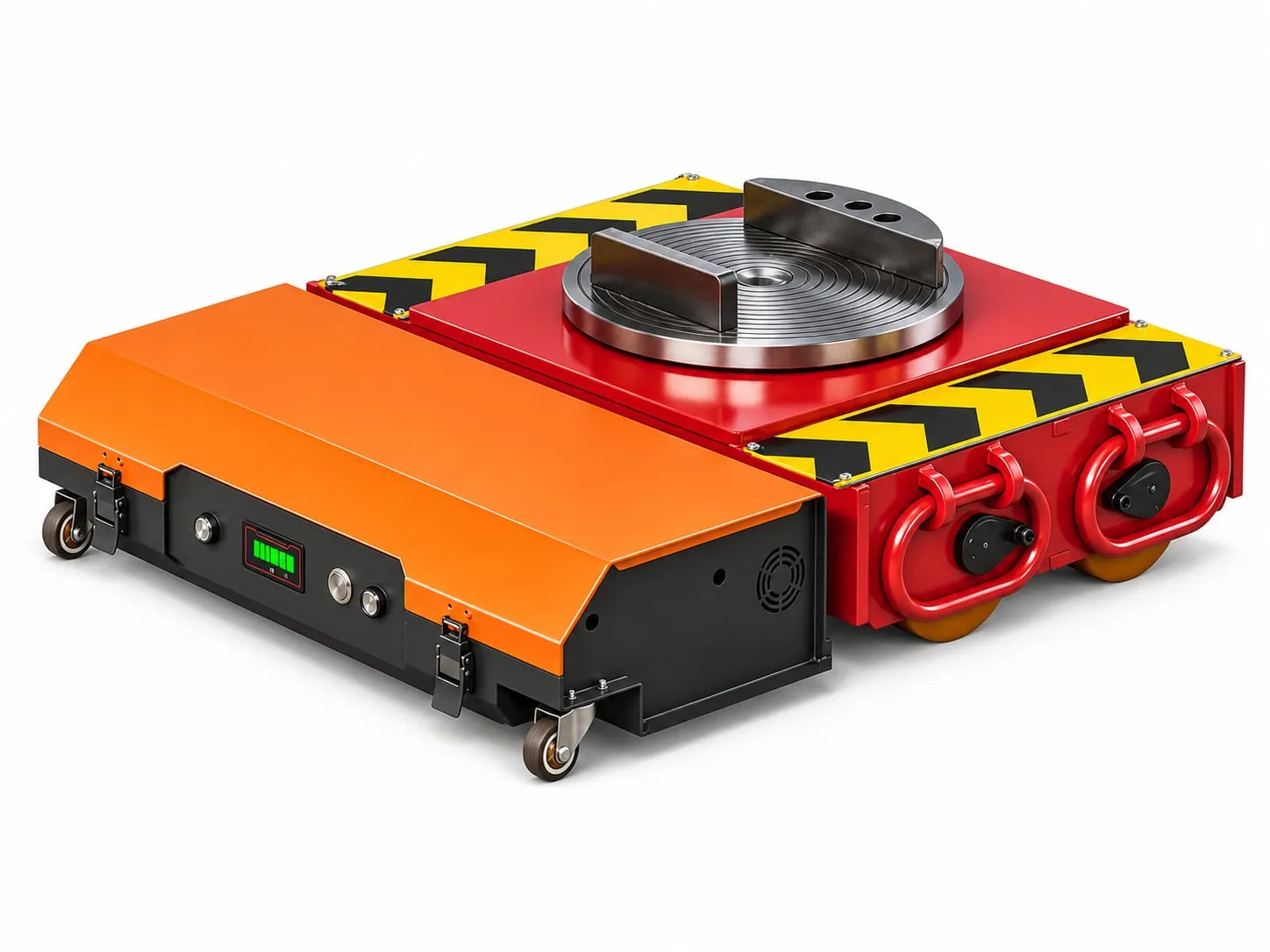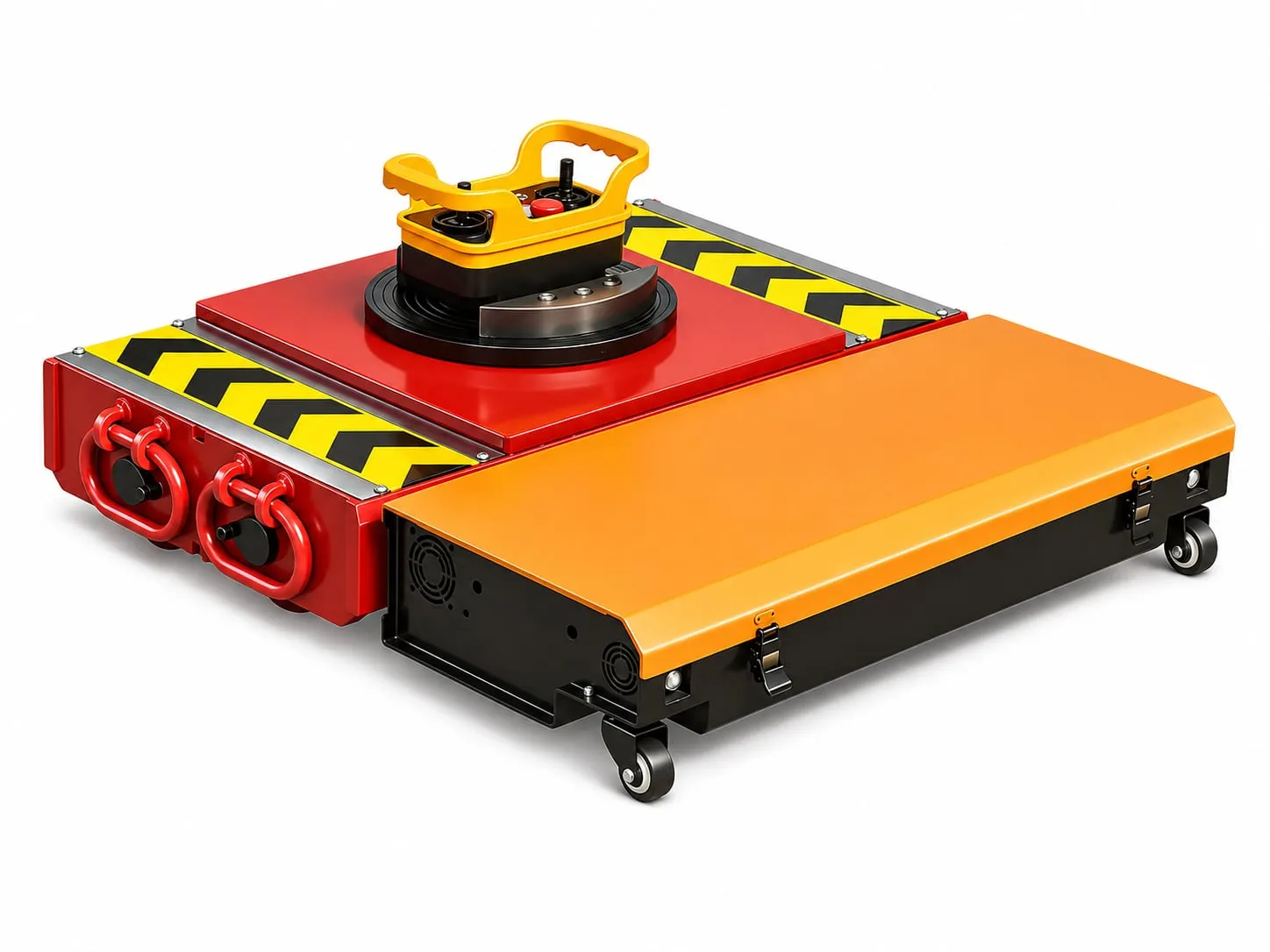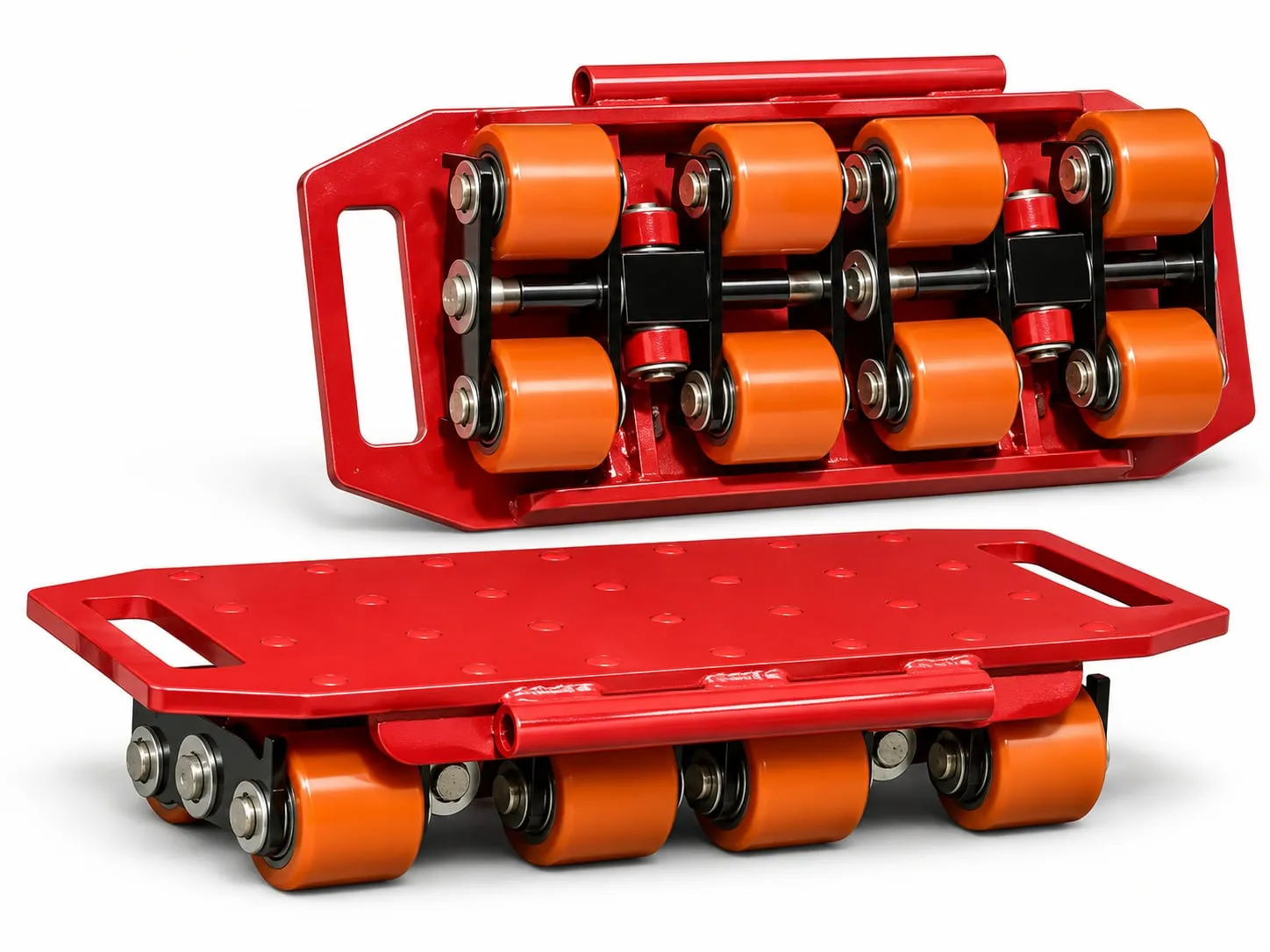
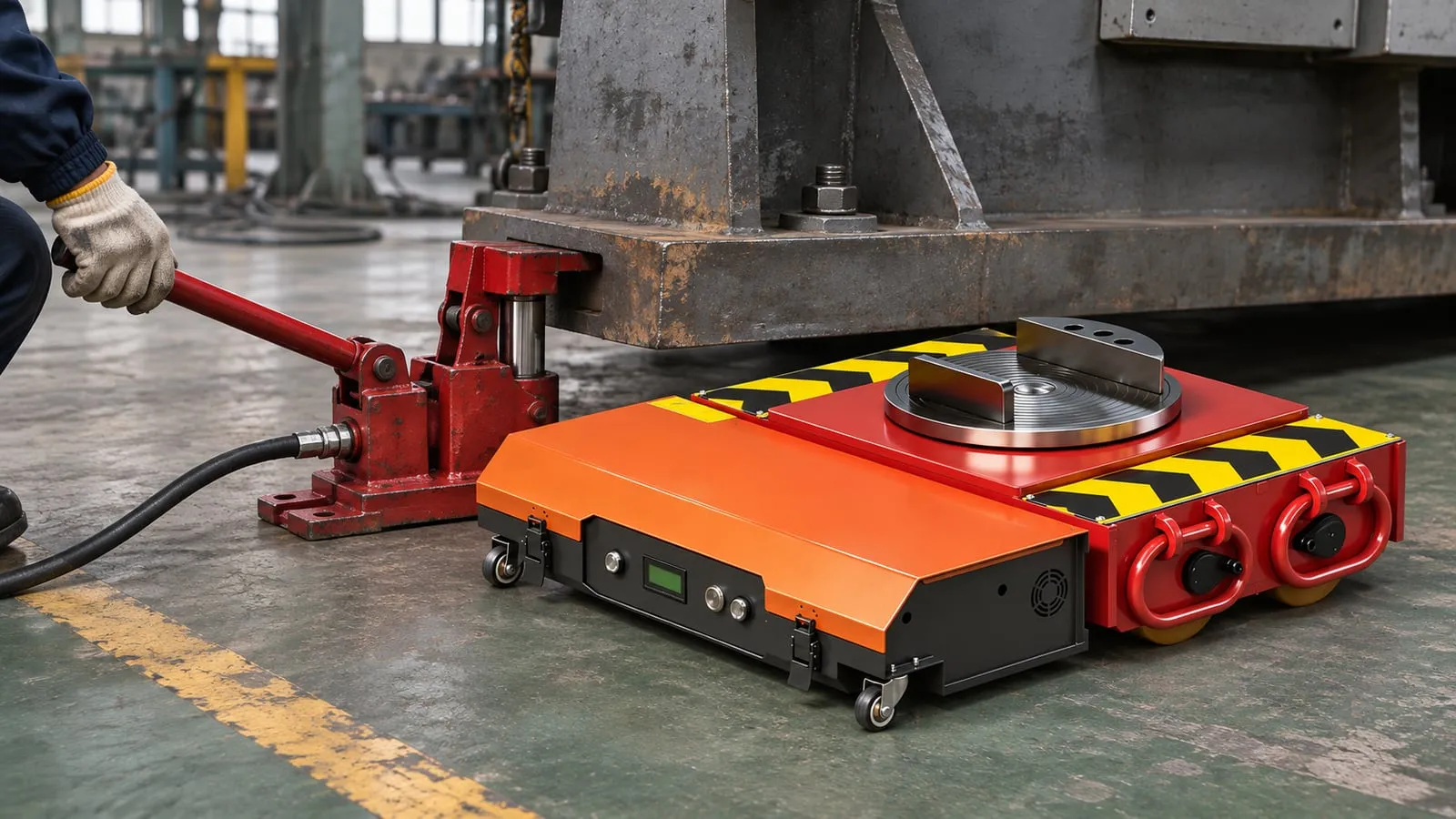
Short answer: To move heavy machinery with electric tank movers, survey the route, confirm the weight and centre of gravity, then raise the machine a few centimetres with rated jacks and crib it at every step. Set one tank mover and two auxiliary cargo trolleys under the base, lower the load, drive the empty route once, then move at creep speed with spotters and lower the machine onto cribbing at the new position.
Step 1: Plan and survey the route
Walk the whole route with a tape measure before you book any equipment. Check:
- Door and aisle widths, plus room to turn: the far end of the load swings wide.
- Slopes. Factory guidance is up to about 15°; check anything steep with us first.
- Floor load. Ask a structural engineer about suspended floors, basements, trench covers and pits.
- Joints, drains and cable covers. Bridge gaps and weak covers with steel plates.
- Overhead obstructions such as pipes and cable trays.
The UK Health and Safety Executive asks for lifting plans in proportion to the risk, with each step and each person’s role written down. For a routine move, one page with a route sketch is enough.
Step 2: Find weight, lifting points and centre of gravity
Use the nameplate, the transport drawing or the original supplier’s data. Add oil, tooling and dies left in the machine. Mark the jacking points on the base, and find where the centre of gravity sits. This decides which end carries more weight. Our guide on sizing a tank mover set covers the load split in detail.
Step 3: Prepare jacks, cribbing and the set
Choose jacks with a rated capacity above the load at each lifting point. US rules for jacks (29 CFR 1926.305) say the rated capacity must be marked and not exceeded, the jack base must be blocked or cribbed on a weak surface, and the load must be cribbed or blocked as soon as it is raised. Claw jacks work under low machine feet; a 48 V lithium hydraulic pump speeds up larger lifts. If there is no jacking point, a crane or forklift lifts the machine instead.
Step 4: Lift a few centimetres and place the units
Lift one end at a time, a few centimetres per stroke, adding cribbing as you go. Raise the base just above the deck height of the units: on a TM-30 that is a little over 185 mm. Slide the tank mover under one end and the auxiliary cargo trolleys under the other. Hilman recommends a three-point layout because it stays stable on uneven floors; this is our usual 1 + 2 set-up. Use 2 + 2 for long or off-centre loads.
Step 5: Lower, secure and test
Lower the load evenly onto the turntable and trolley decks. Check that every unit sits flat and fully under the base. Strap long trolleys to the load so they cannot creep out. Chock the trolleys while you remove the jacks. Then drive the tank mover along the route without the load to confirm the turns and the floor.
Step 6: Move, turn and position
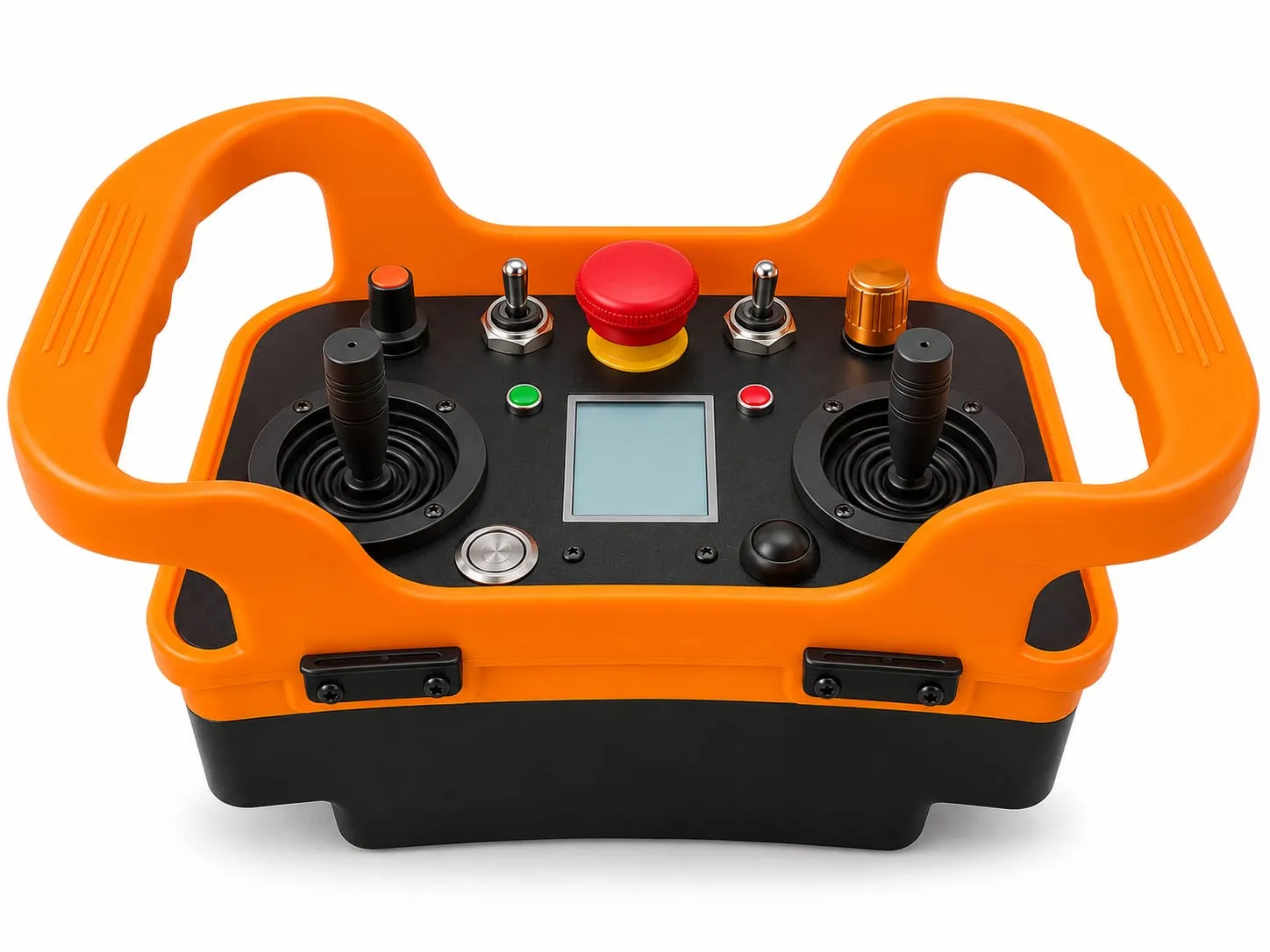
Set the speed low (the range is 2–10 m/min) and move with a spotter at each pinch point. Stop before doors and turns. Turn in small steps using the Ø290 mm 360° turntable, watching the far end. An industrial remote with emergency stop and a 0–10 speed dial gives finer control. At the new position, jack the load up again, pull the units out and lower it onto its feet or the new foundation.
Checklist
| Step | Who | Check |
|---|---|---|
| Route survey | Supervisor | Widths, slopes, floor load, joints, overhead |
| Weight and CoG | Supervisor / engineer | Nameplate, drawing, extras left in the machine |
| Lifting | Rigger | Jack rating, cribbing at every step, nobody under the load |
| Set-up | Rigger + operator | Units flat and fully under the base, trolleys strapped |
| Test run | Operator | Empty route, turns, battery charge |
| Move | Operator + spotters | Creep speed, stops at doors and turns |
| Lift-off | Rigger | Cribbing first, then pull units, then lower |
Example: a 24 t press on a TM-30 set
Example (illustrative figures): A 24 t press has its support points 3.0 m apart. The centre of gravity is 1.8 m from the tank mover end and 1.2 m from the trolley end.
- Load on the tank mover = 24 t × 1.2 ÷ 3.0 = 9.6 t. A TM-30 carries up to 15 t, so it fits with headroom.
- Load on the trolley end = 24 t − 9.6 t = 14.4 t, or 7.2 t on each of two trolleys. Two 4-roller trolleys (12 t each) are suitable.
- Jacking height: just over 185 mm to clear the TM-30 deck.
- Travel: an 80 m route at 4 m/min is about 20 minutes of driving. With stops and turns, plan an hour. The TM-30 runs 3–4 h per charge, so one full charge covers the move.
Safety notes
- Never stand or reach under a raised load; keep feet clear of wheels and rollers.
- Crib at every lift stage and chock trolleys during jacking.
- Stop if the floor cracks, a unit tilts or the load shifts.
For when tank movers beat other methods, see tank movers vs forklifts, cranes and rollers. Buying a set? Read our price and buying guide or send us your load details.