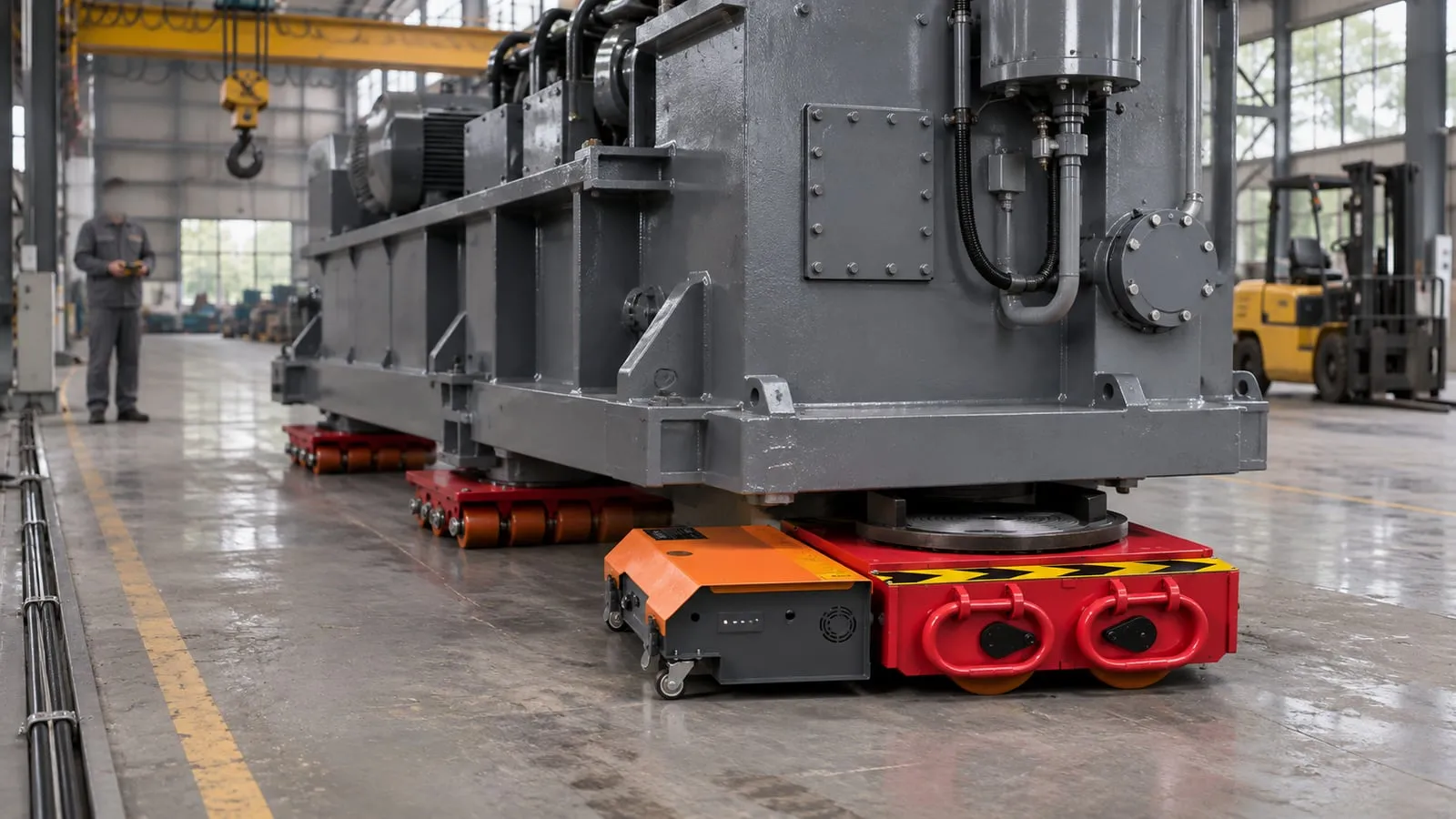
Short answer: Many heavy machines inside a plant are moved without a crane: they are jacked up a few centimetres and rolled on electric tank movers, manual roller skates or air skates. Cranes and forklifts still win in some jobs, mainly when the load must be lifted high, set into a pit or loaded onto a truck. The right choice depends on weight, floor, headroom, distance and crew.
The six common methods
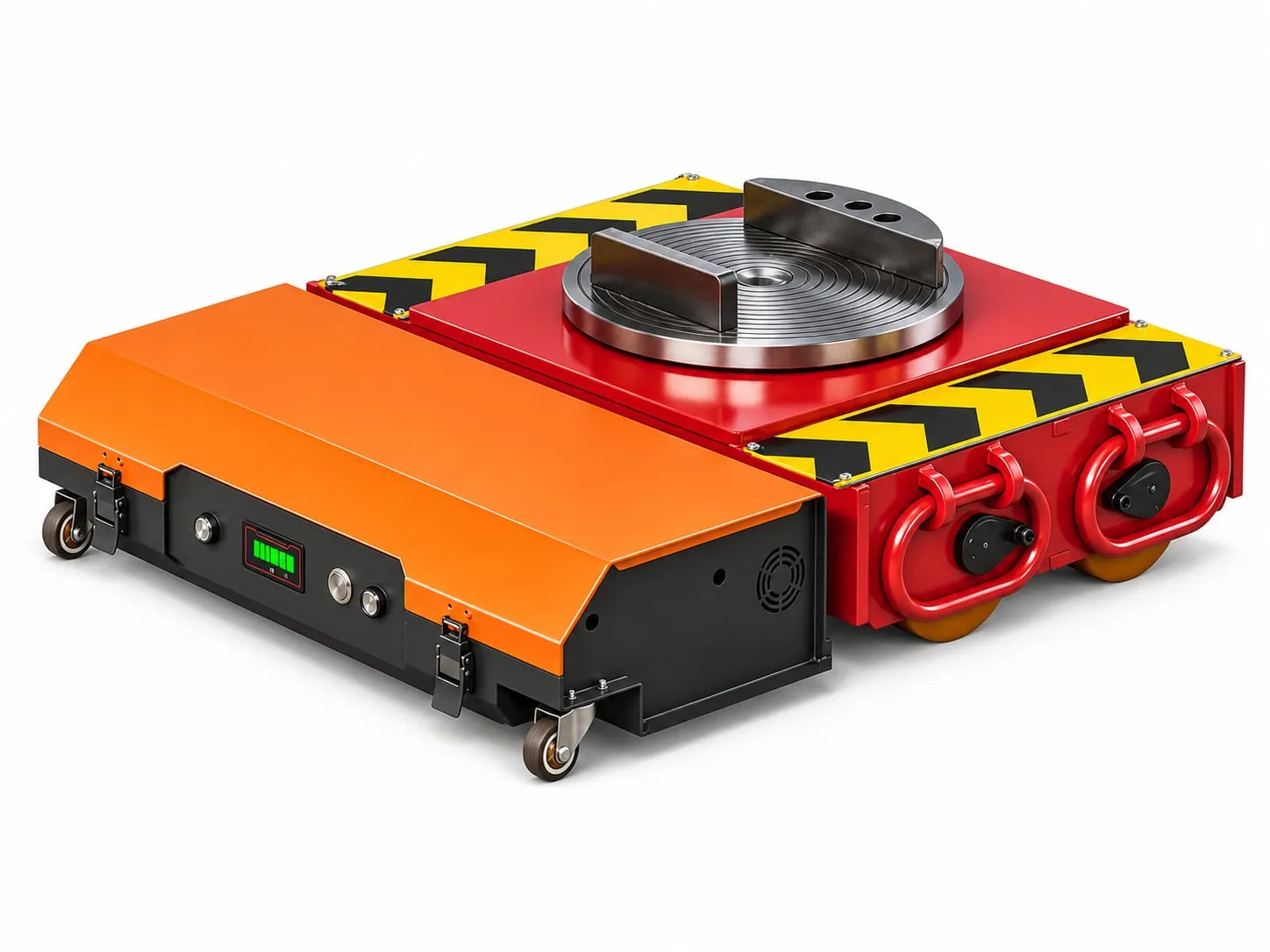
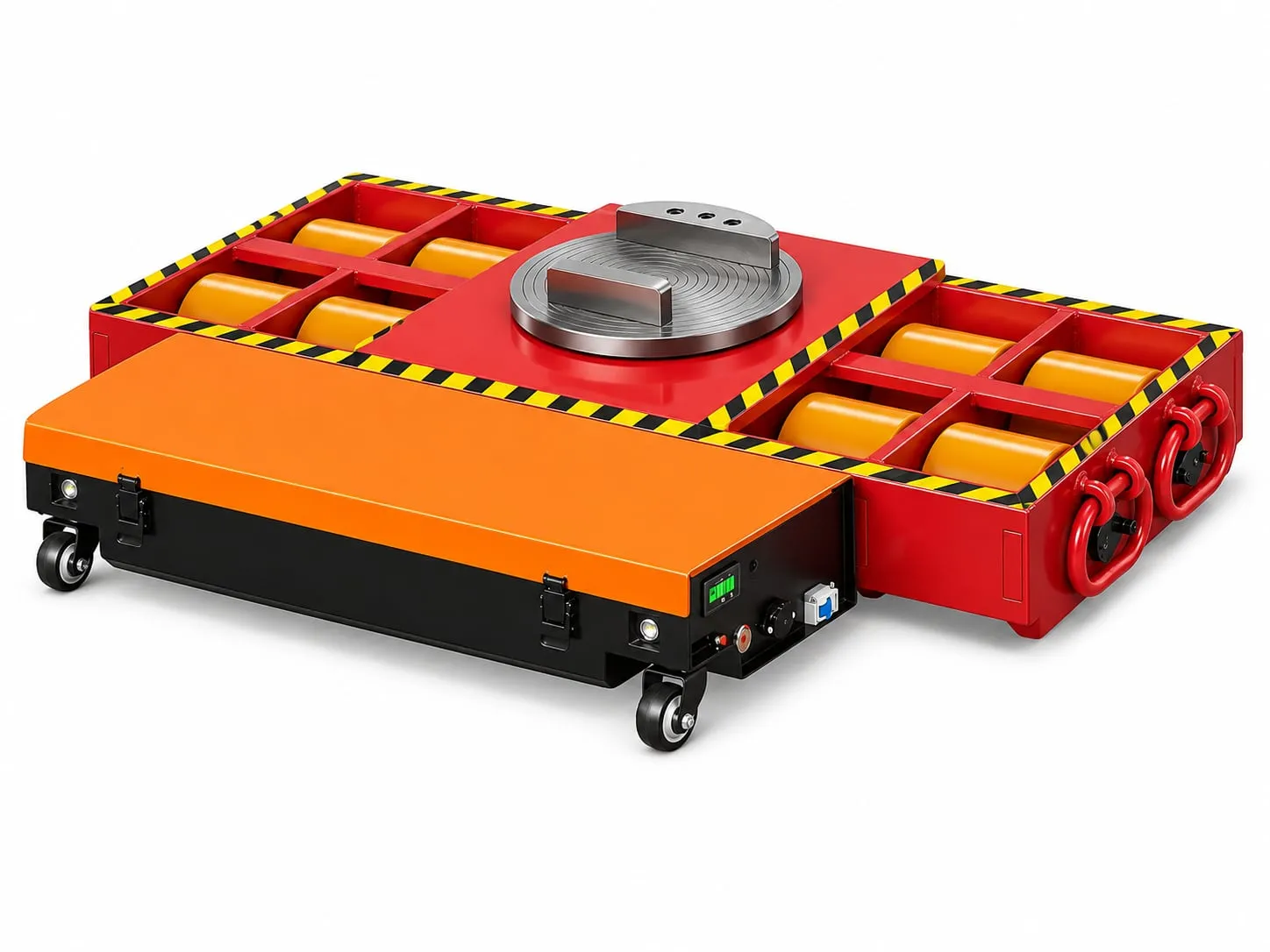
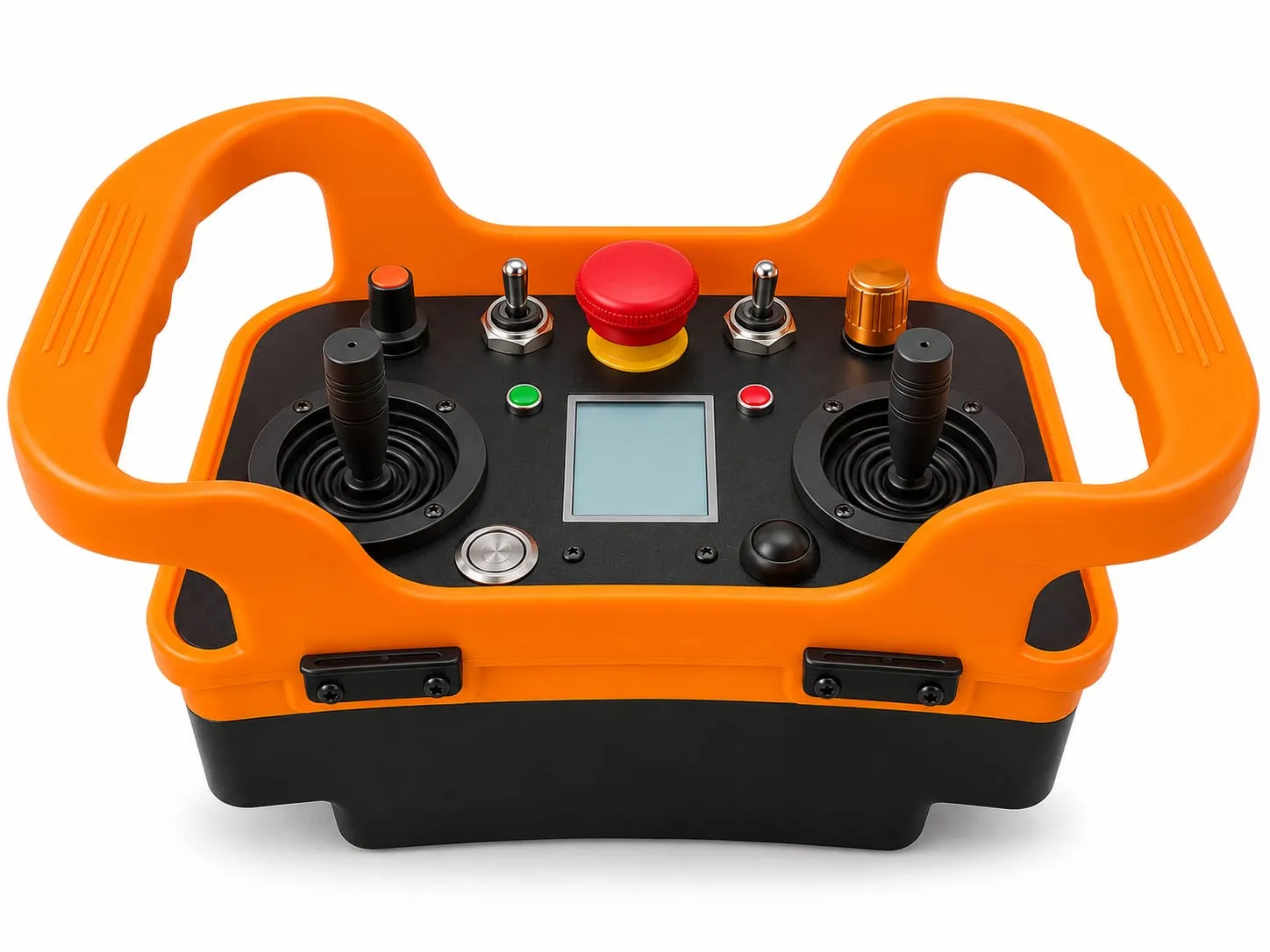
Electric tank movers. A battery-powered drive unit goes under one end of the load, auxiliary cargo trolleys under the other. One operator steers by remote control at 2–10 m/min. Our range covers sets from 10 t to 60 t; see how to size a set.
Forklifts. Fast and available in most plants. A forklift is rated at a stated load centre, and its counterweight balances that rating. A long, wide or high machine shifts the load centre forward and cuts the safe capacity. US OSHA rules state that only loads within the truck’s rated capacity may be handled, and that modifications affecting capacity need the manufacturer’s prior written approval, so bolting on extra counterweight is not an option.
Cranes (overhead, gantry or mobile). The only practical way to lift a load over obstacles or into a pit. An overhead crane only reaches its own bay; a mobile crane needs road access, outrigger space and headroom. The UK HSE expects every lifting operation to be planned by competent people, with a written plan for complex lifts.
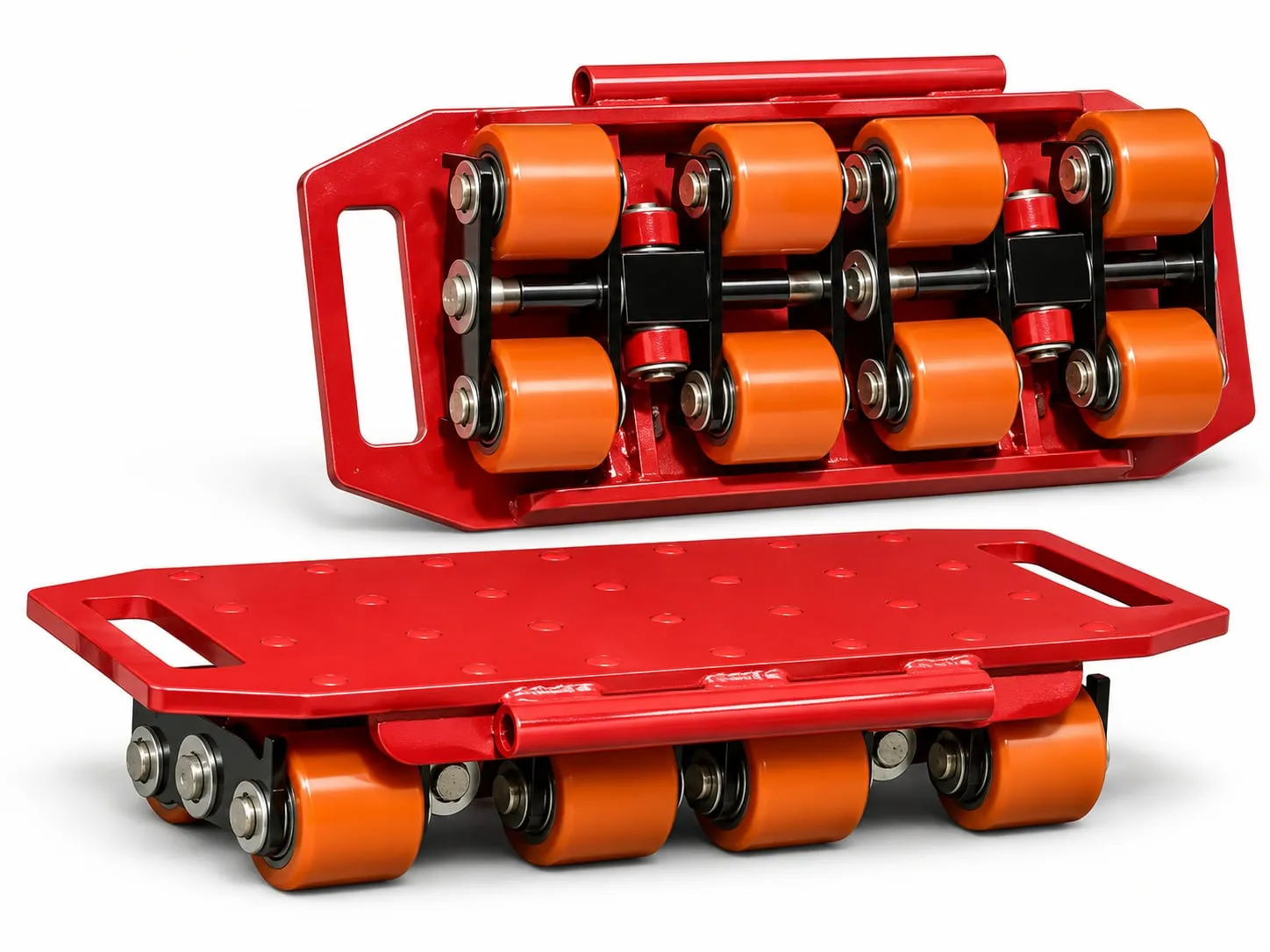
Manual roller skates with pull bars. Simple, low-profile rollers placed under the load, steered with handles and pushed or pulled by a crew or a winch. Roller suppliers such as Hilman advise choosing the roller material for the floor and locking the rear swivels so the load does not fishtail.
Air skates (air casters). The load floats on a film of compressed air and needs very little push force. Hovair notes they work best on level, smooth, non-porous floors; porous floors need a sheet overlay.
Hydraulic gantries. Telescopic towers on a track lift the load and travel along the runway. They suit lifts where there is no crane and not enough headroom for a mobile one, but they need set-up time and a trained crew.
Comparison table
The table is qualitative. Ratings vary widely between makes, so check the actual equipment you are considering.
| Electric tank movers | Forklift | Overhead / mobile crane | Manual rollers | Air skates | Hydraulic gantry | |
|---|---|---|---|---|---|---|
| Typical use | Long indoor moves | Short moves, loading | Vertical lifts | Short moves | Heavy loads on good floors | Lifts without a crane |
| Floor needs | Firm, even concrete | Firm, even | Crane pad / outrigger ground | Firm, even, clean | Smooth, sealed, crack-free | Level track base |
| Headroom | Only for jacking | Mast height | High | Only for jacking | Only for lifting the casters | High |
| Crew | 1 operator + spotter | 1 driver + spotter | Operator, slinger, supervisor | Several people or a winch | Small crew + air supply | Trained crew |
| Speed over distance | Steady, 2–10 m/min | Fast | Limited by reach | Slow, tiring | Moderate | Slow |
| Set-up time | Short (jacking) | Very short | Long for mobile cranes | Short (jacking) | Medium (air hoses) | Long |
| Relative cost to own | Medium | Medium to high | High | Low | Medium | High |
When each method wins
- Electric tank movers win for 10–60 t machines that travel tens or hundreds of metres along aisles, through doors or between halls, with a small crew. The 360° turntable lets the load turn in narrow spaces; four synchronised movers on one industrial remote move it sideways.
- Forklifts win when the load sits well inside the truck’s rated capacity at the real load centre and the move is short.
- Cranes win when the machine must be lifted over something, set on a raised foundation or loaded onto a trailer.
- Manual rollers win for occasional short moves on a budget.
- Air skates win on clean, sealed floors where low floor pressure matters.
- Hydraulic gantries win for high lifts where no crane can reach.
Methods are often combined: a gantry or crane lifts the machine off the truck, then tank movers take it to its foundation.
Example: a 30 t CNC machine, 80 m across the plant
Example (illustrative, not a real job): a 30 t machining centre must travel 80 m along an aisle and through a 4 m door. A forklift for 30 t at that load centre is a large, specialised truck. The overhead crane does not reach the second hall. A crew on manual rollers works, but pushing 30 t for 80 m is slow and tiring. At 2–10 m/min, a TM-30 or larger set covers 80 m in about 8 minutes at top speed, or about 40 minutes creeping at 2 m/min, driven by one operator with a spotter. Jacking and setting down usually take longer than the travel itself.
Next steps
For the full method, read how to move heavy machinery with tank movers. Rental companies can read about starting a machinery moving rental fleet. See the 60 t model for the heaviest loads, or contact us with your machine and route.