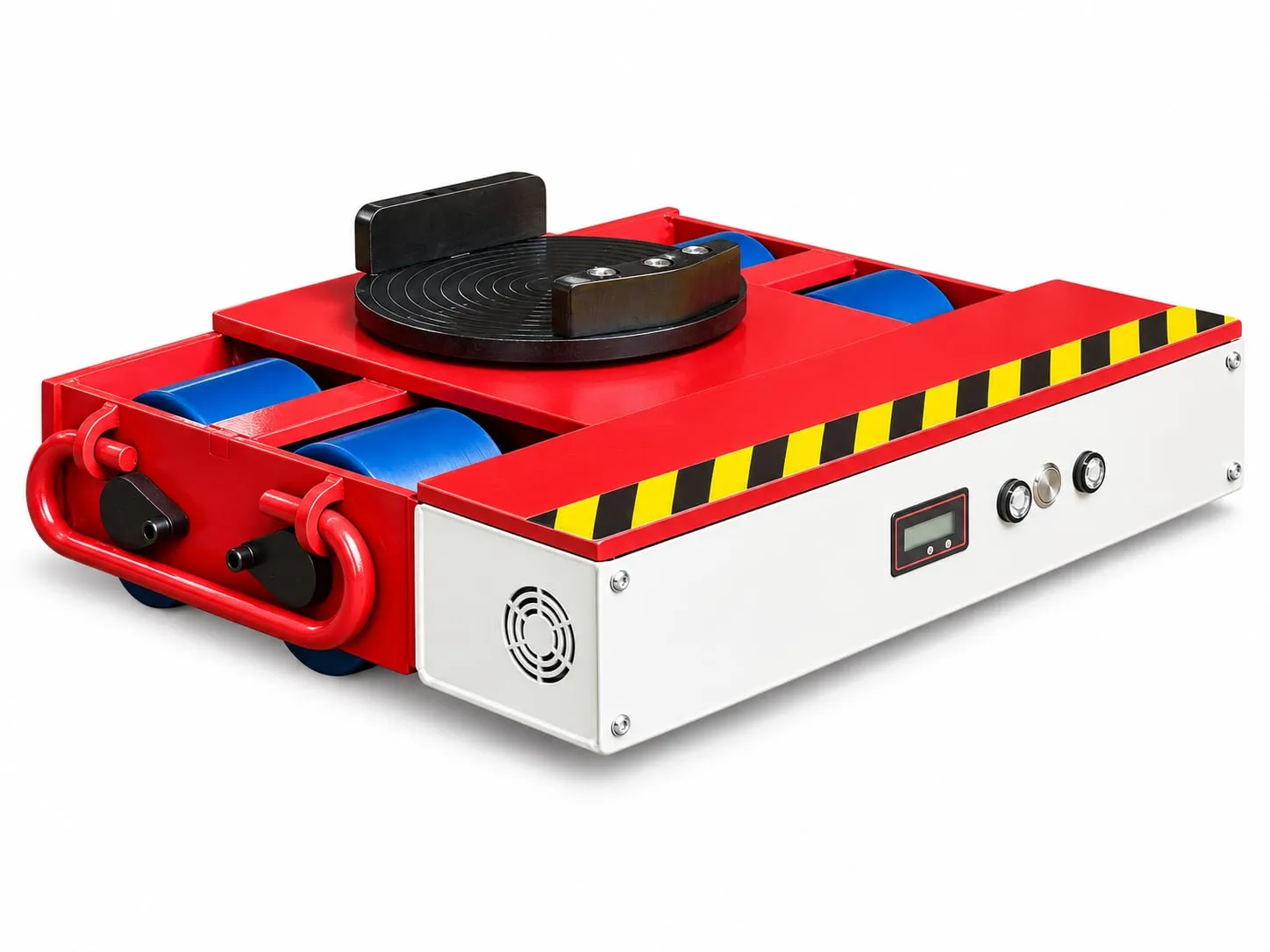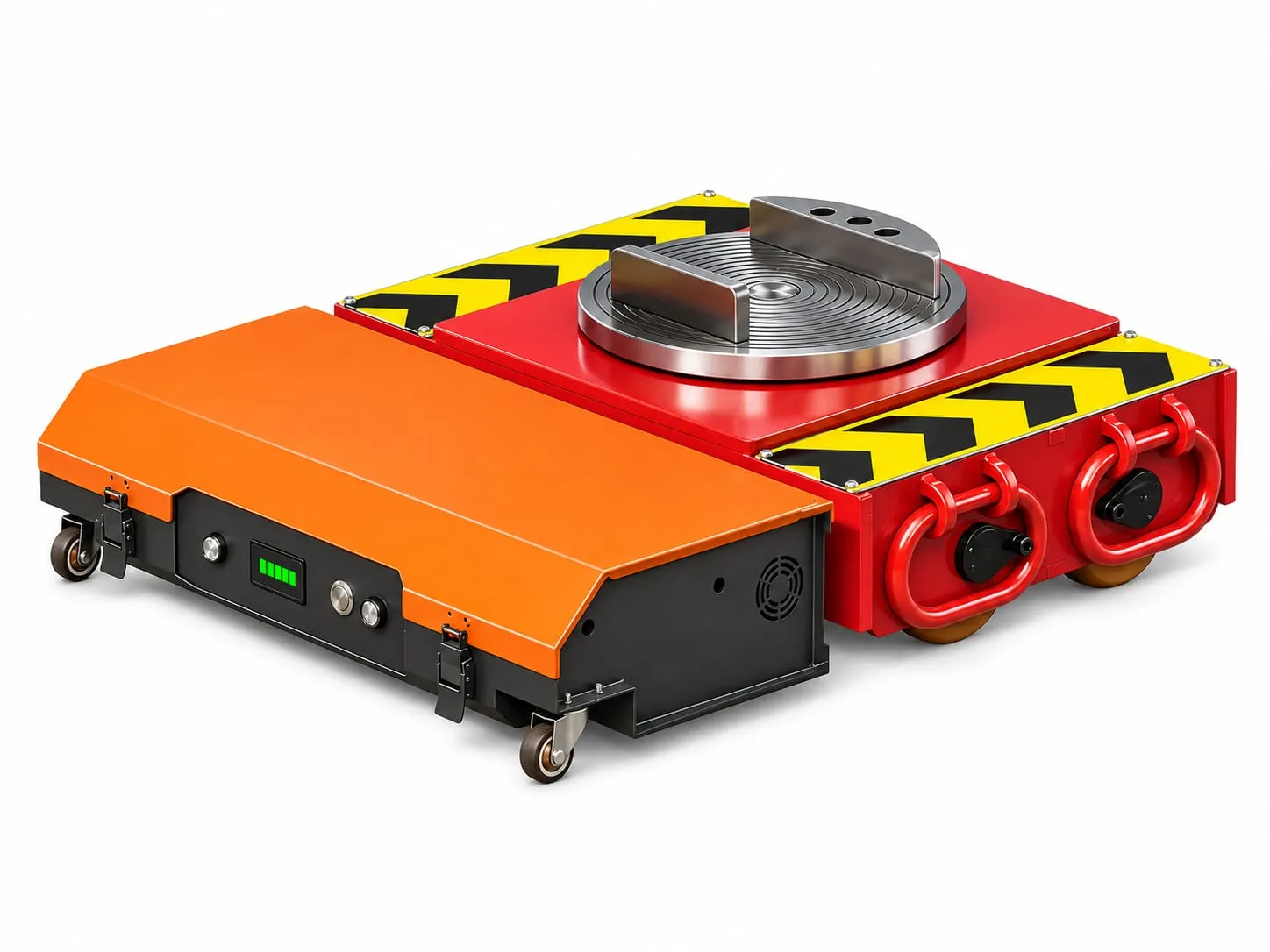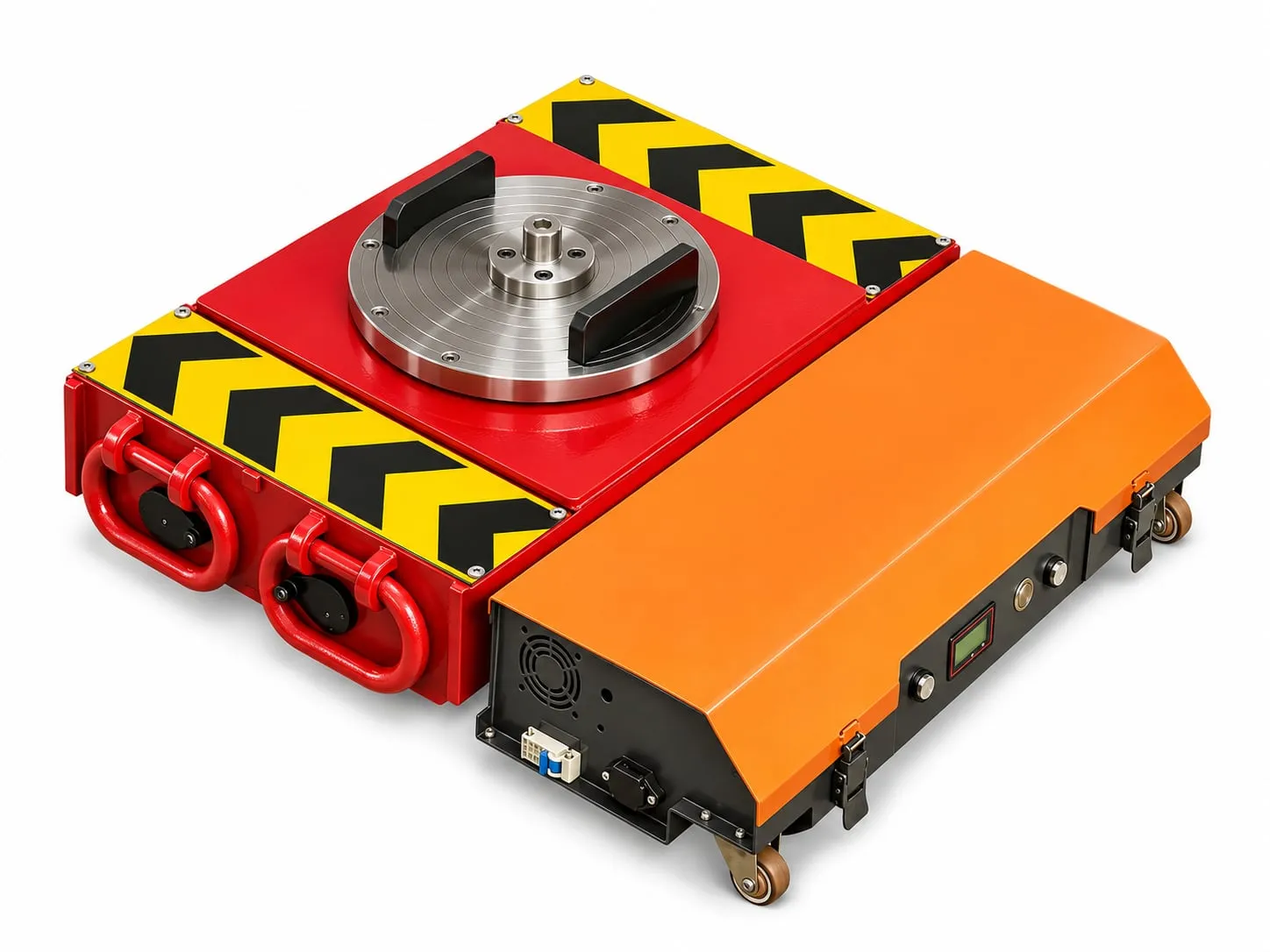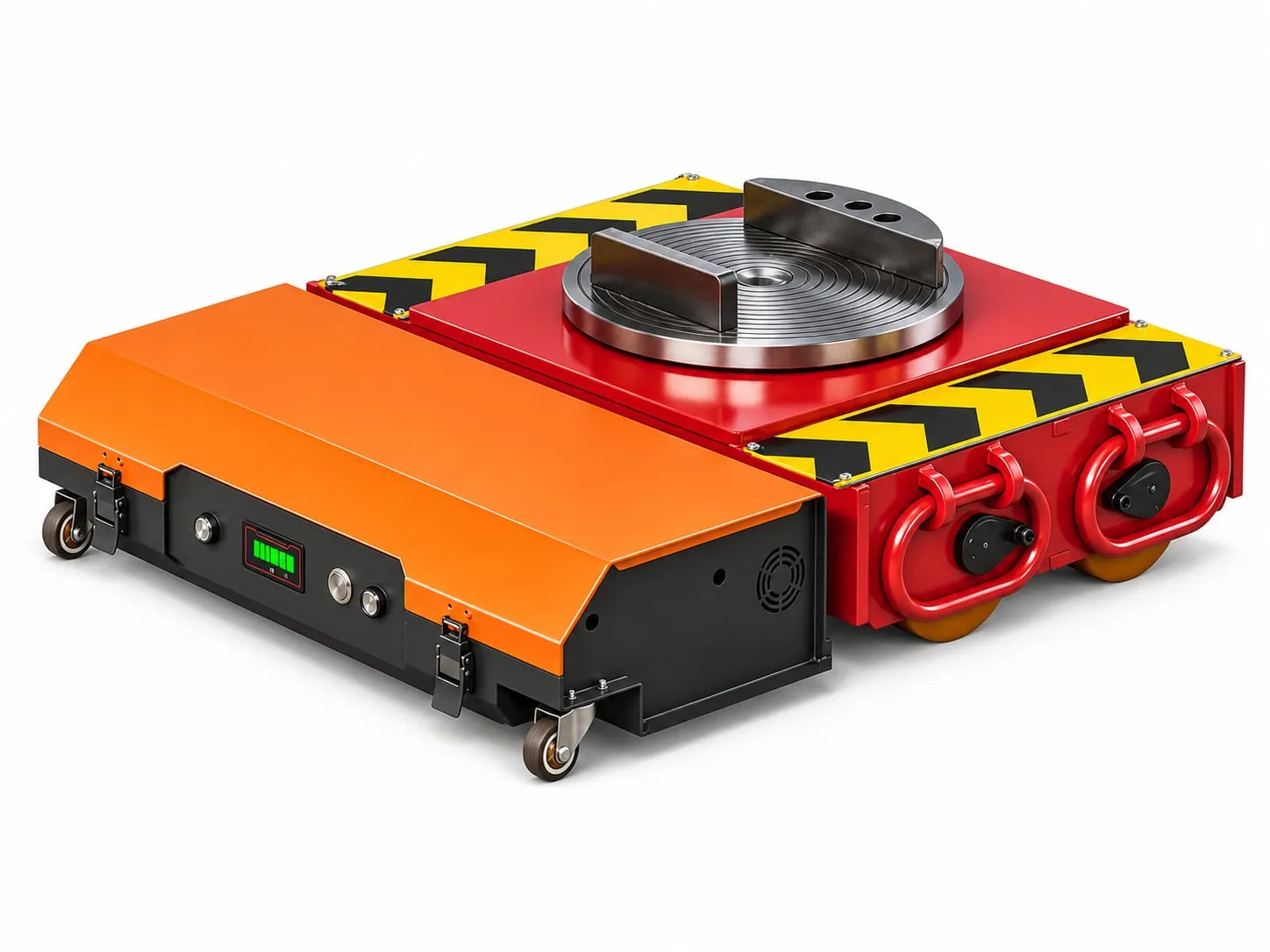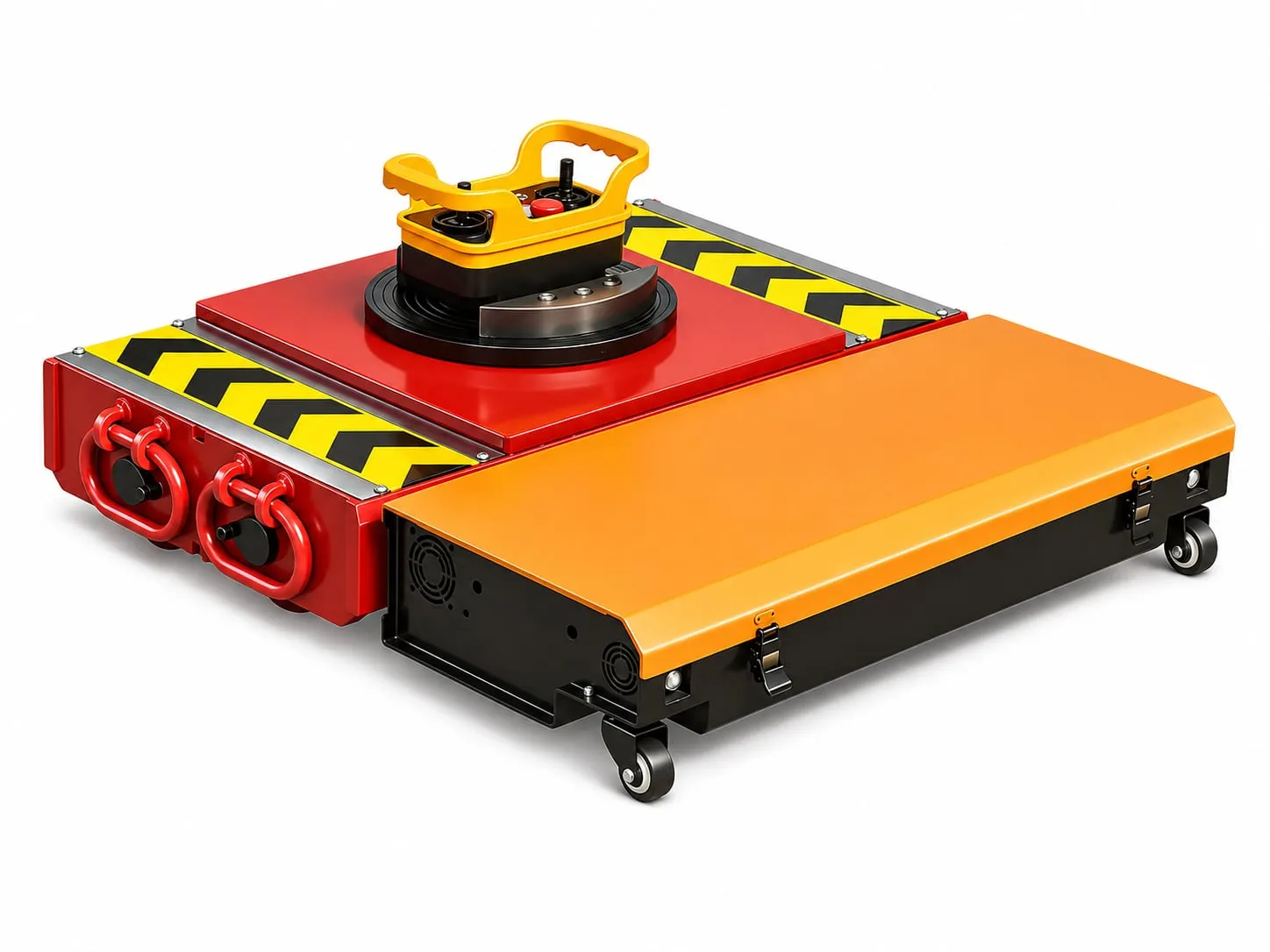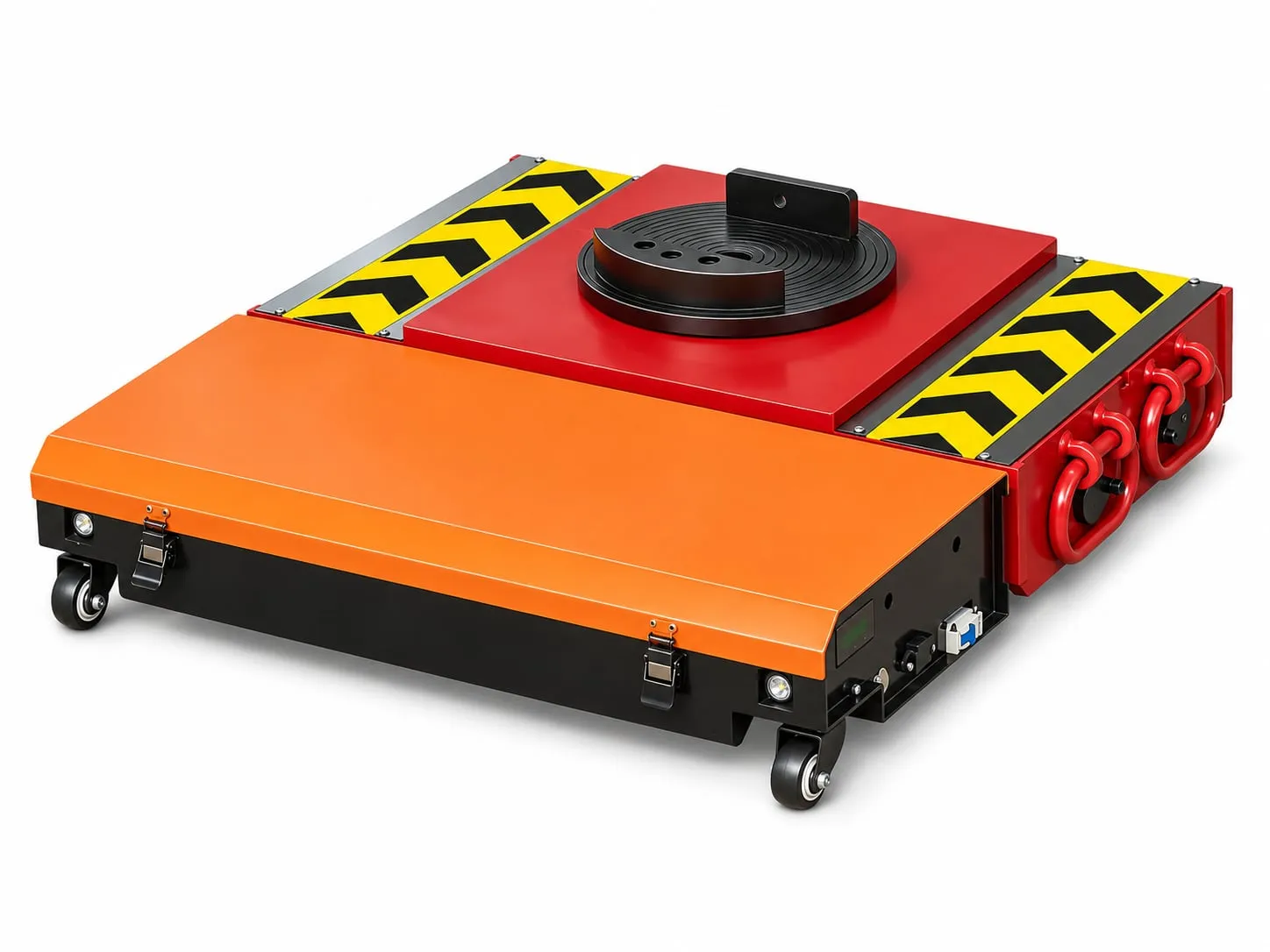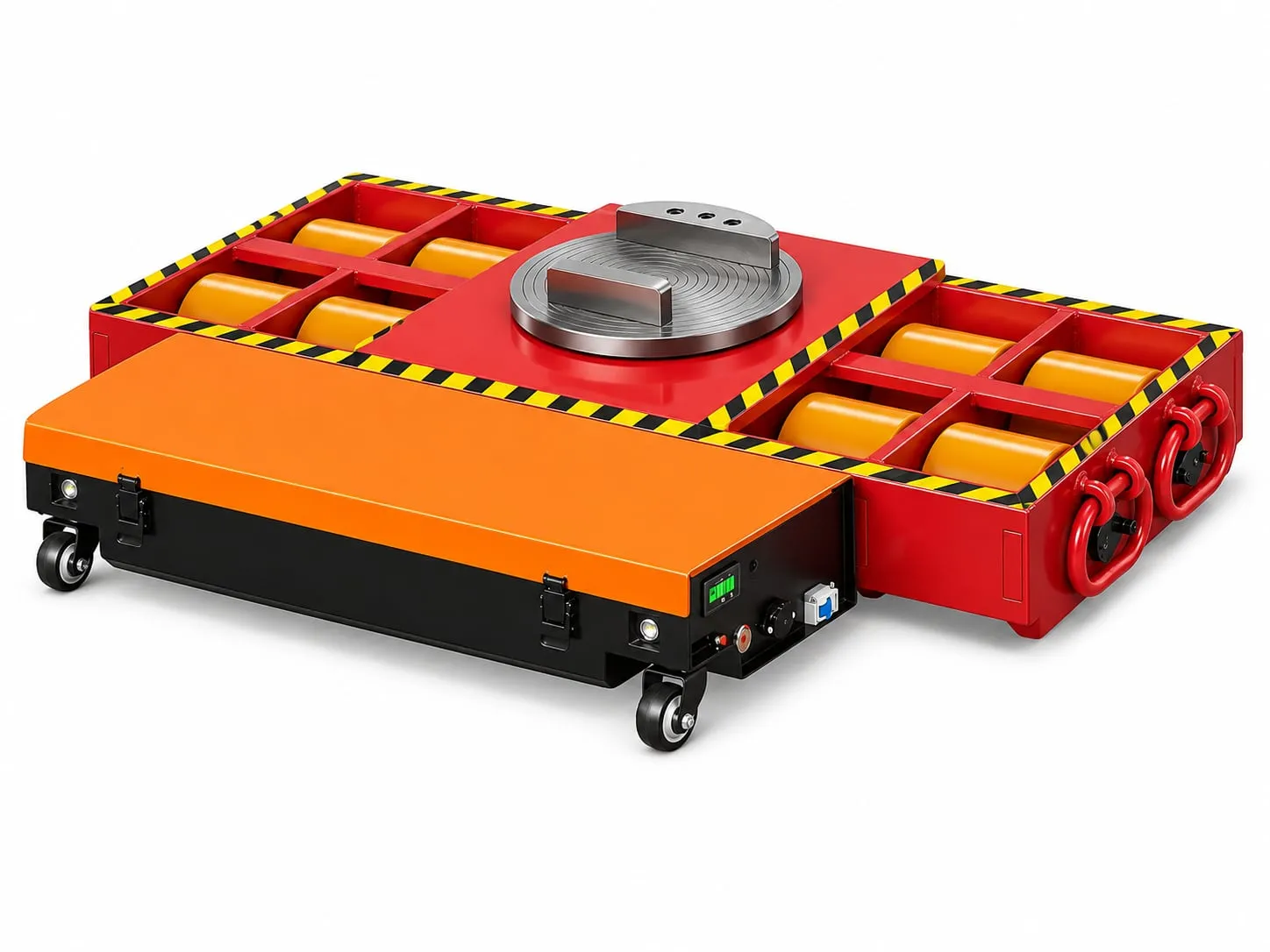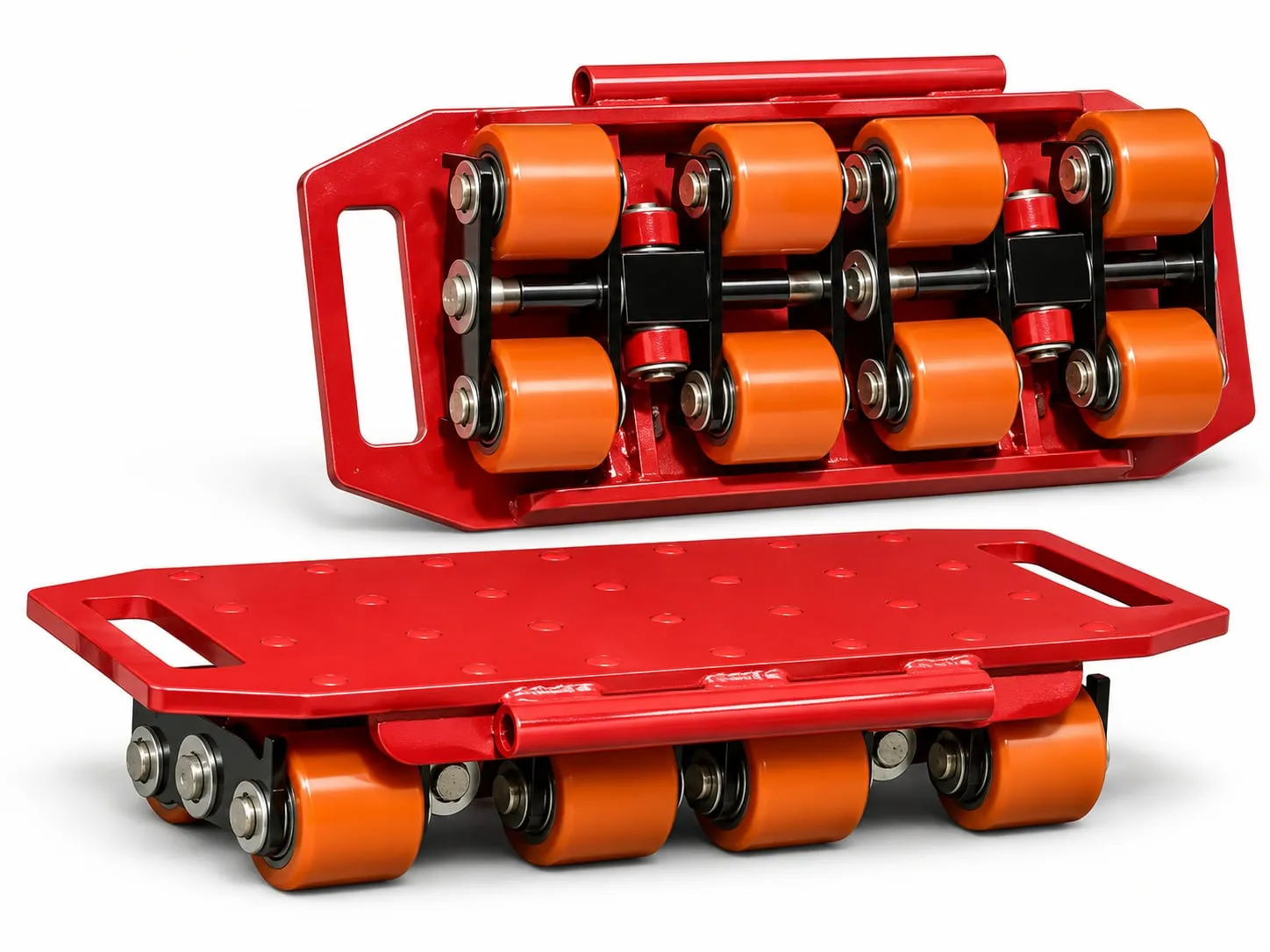
Short answer: To move a transformer, generator set or heavy mould, jack it at the maker’s marked points, set a 40–60 t electric tank mover set underneath and drive it by remote control. For long or off-centre loads use two tank movers plus two auxiliary trolleys; for a sideways move into a tight bay, run four tank movers on one industrial remote.
What makes heavy equipment different
Transformers, generator sets, large injection moulds, tanks and pressure vessels are dense. A lot of weight sits on a small footprint, and the centre of gravity is often high or off-centre. Many units have delicate parts on the outside: bushings, radiators and conservators on a transformer, pipework and control panels on a generator, nozzles on a vessel. You cannot jack or bear on just any flat surface.
These loads often go into tight places too: substation bays, basement plant rooms, generator halls. Cranes may not reach, and forklifts large enough to carry the load may not fit. Enerpac describes one such job: four 16 t transformers moved along a 20 m basement corridor with a hydraulic skidding system and climbing jacks, because there was no room for lifting equipment. Electric tank movers solve the same problem in a different way: powered wheels instead of skid beams, with less set-up along the route on a sound, flat floor.
Planning the move
Weight and centre of gravity. Take them from the nameplate, the outline drawing or the maker’s handling instructions. If the drawing gives a centre of gravity, use it to split the load between the ends. If it does not, assume an offset, never a perfect 50/50.
Jacking and support points. Transformers and generator skids usually have marked jacking pads or a base frame designed to be supported. Place jacks and the tank mover turntable only there. Do not bear on radiators, cooling fins, tank walls or panels.
Route. Check floor capacity (ask the site engineer about slabs over cable basements and trenches), door widths, overhead clearance, slopes (up to about 15°, check with us) and any outdoor surface. On compacted ground we fit wider polyurethane wheels.
Plan and people. The UK HSE requires lifting operations to be planned by a competent person, supervised and carried out safely. Jacking a 40 t transformer onto tank movers is a lifting operation; write it into the method statement.
Choosing the set for heavy loads
The model number is what a complete set can move; each tank mover carries half of that number.
| Load | Typical set-up | Why |
|---|---|---|
| Compact transformer or generator set, up to about 30 t | TM-30 to TM-50 + 2 auxiliary trolleys | Standard three-point set; most jobs |
| Large transformer or mould, 30–60 t | TM-60 + 2 large trolleys, or 2 tank movers + 2 trolleys | Tank mover carries up to 30 t; 2 + 2 spreads the load |
| Long tank or pressure vessel | 2 tank movers + 2 trolleys | Four support points along the length |
| Any heavy load entering a narrow bay sideways | 4 tank movers on one industrial remote | Sideways travel without turning |
| Over 60 t | Several tank movers + 20-roller trolleys (60 t each) | Contact us with drawings |
Match the auxiliary cargo trolleys to the passive end. The 8-roller (24 t), 10-roller (30 t) and 12-roller (36 t) units pair with 30–60 t sets; the four-row 20-roller unit carries 60 t.
Synchronised control
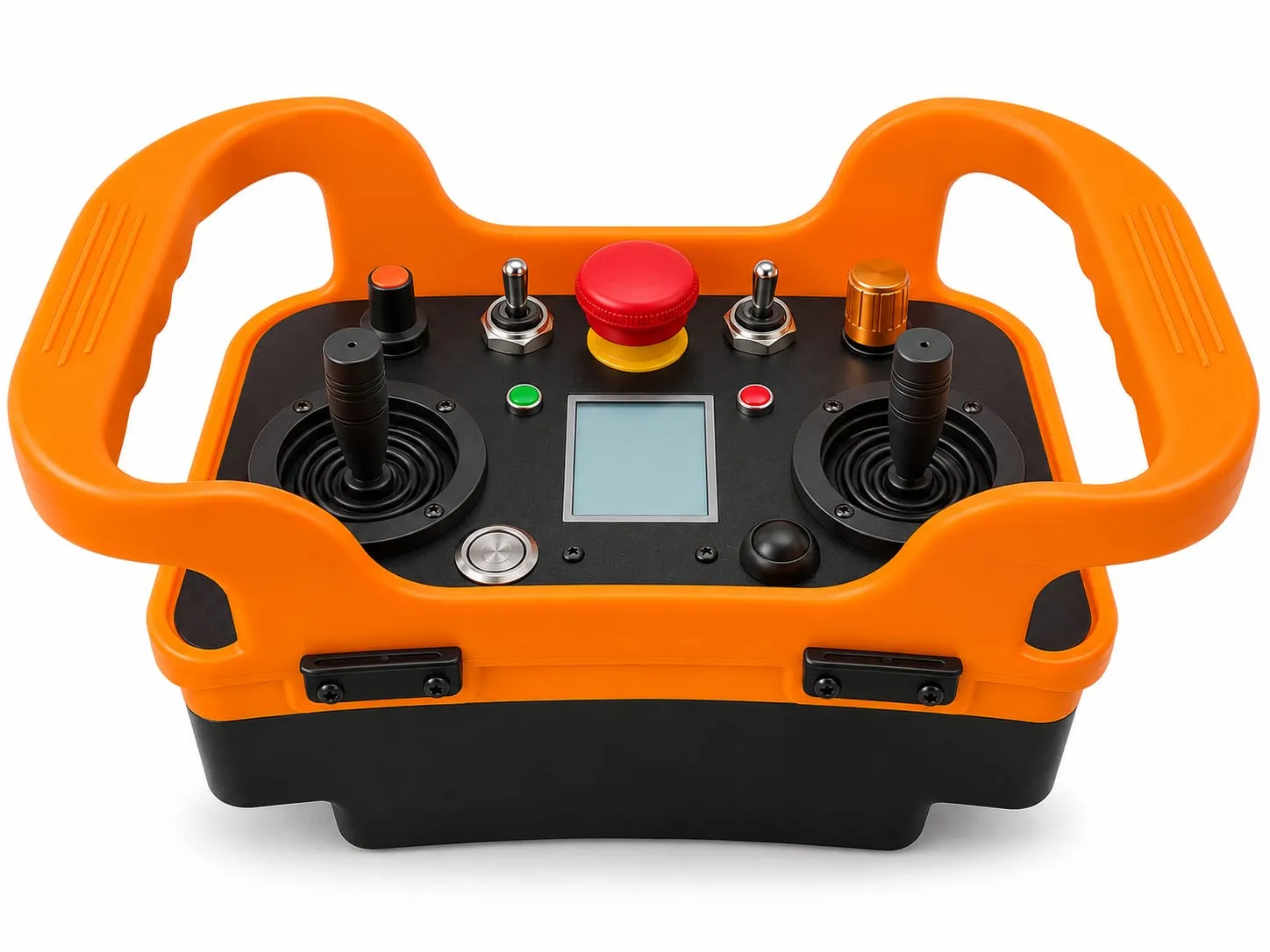
The industrial remote can drive 2 or 4 tank movers together. With two tank movers at the ends of a long vessel, both drive units push together, so the load does not twist. With four tank movers under the four corners and turntables set the same way, the whole load can travel sideways, which is useful for sliding a transformer into a bay that is only slightly wider than the unit. The remote also gives a 0–10 speed dial, cruise mode and an emergency stop.
Step by step
- Read the maker’s handling instructions; remove or secure parts they list.
- Jack evenly at the marked points with hydraulic jacks (a 48 V lithium hydraulic pump is available), building cribbing as the load rises.
- Set the tank mover(s) and auxiliary trolleys at the support points and lower the load onto them.
- Remove the jacks, check the load is level, and test the emergency stop.
- Drive at low speed (2–10 m/min range) with spotters at every corner.
- At the final position, jack the load off, remove the movers and lower it onto its plinth.
Tank movers compared with skidding systems and cranes
| Method | Set-up along the route | Steering | Best fit |
|---|---|---|---|
| Electric tank movers | Steel plates over gaps only | Turntable; sideways with 4 units | Flat floors, routes with turns, repeated moves |
| Hydraulic skidding system | Skid track laid ahead of the load | Straight runs; re-lay track to change direction | Very heavy loads, weak or uneven floors |
| Mobile crane | Crane pad and swing area | Not applicable | Outdoor lifts with clear access |
| Manual roller skids | None | Pushed or winched | Short, flat, straight moves |
More on the trade-offs: tank movers vs forklifts, cranes and rollers.
Example: a 42 t transformer
Example (illustrative numbers, not a customer job): a transformer weighs 42 t and its drawing puts 55% of the weight at the end with the tap changer.
- Heavy end on one TM-60: 42 t × 0.55 = 23.1 t. The TM-60 carries 30 t, so there is margin.
- Light end on two auxiliary trolleys: 42 t × 0.45 = 18.9 t, or 9.5 t each. Two 8-roller trolleys (24 t each) cover this.
- Sideways option: four TM-40 tank movers on one industrial remote. The heavy pair carries 23.1 t ÷ 2 = 11.6 t each, well within the TM-40’s 20 t.
A 40 m route at 3 m/min is about 13 minutes of driving, inside the 4–5 h run time of the TM-40 to TM-60. Full method: how to size an electric tank mover set.
Safety points for dense loads
- Keep everyone out of the space between the load and walls or other equipment.
- Never work under a load held only by jacks; use cribbing.
- Watch for a high centre of gravity on slopes; go slow and check with us before any ramp.
- Stop if a support point slips or a trolley runs out of line.
For the general method see how to move heavy machinery with tank movers; for budgets, the buying guide. Send us the weight, drawing and route and we will propose a set: contact us.