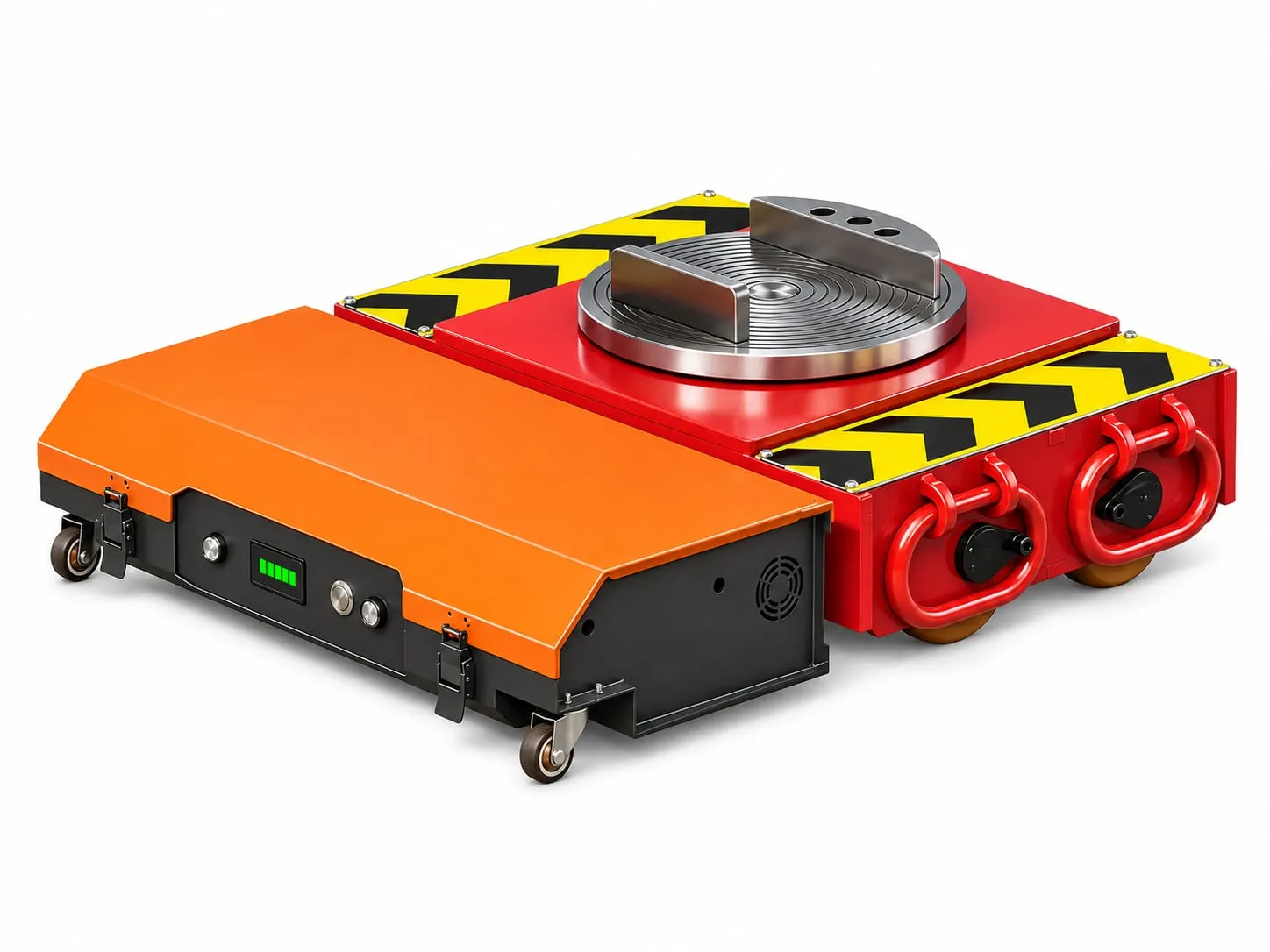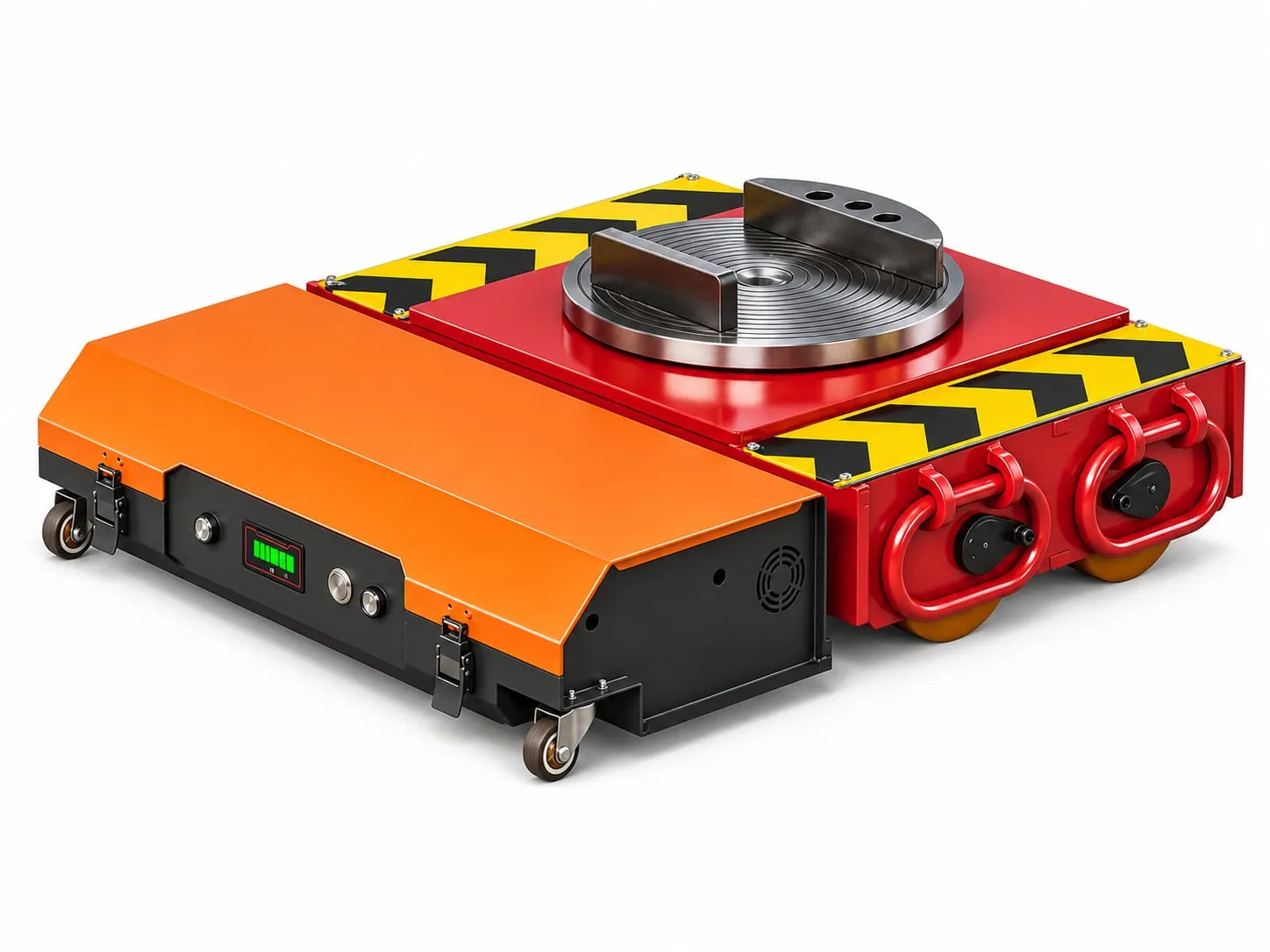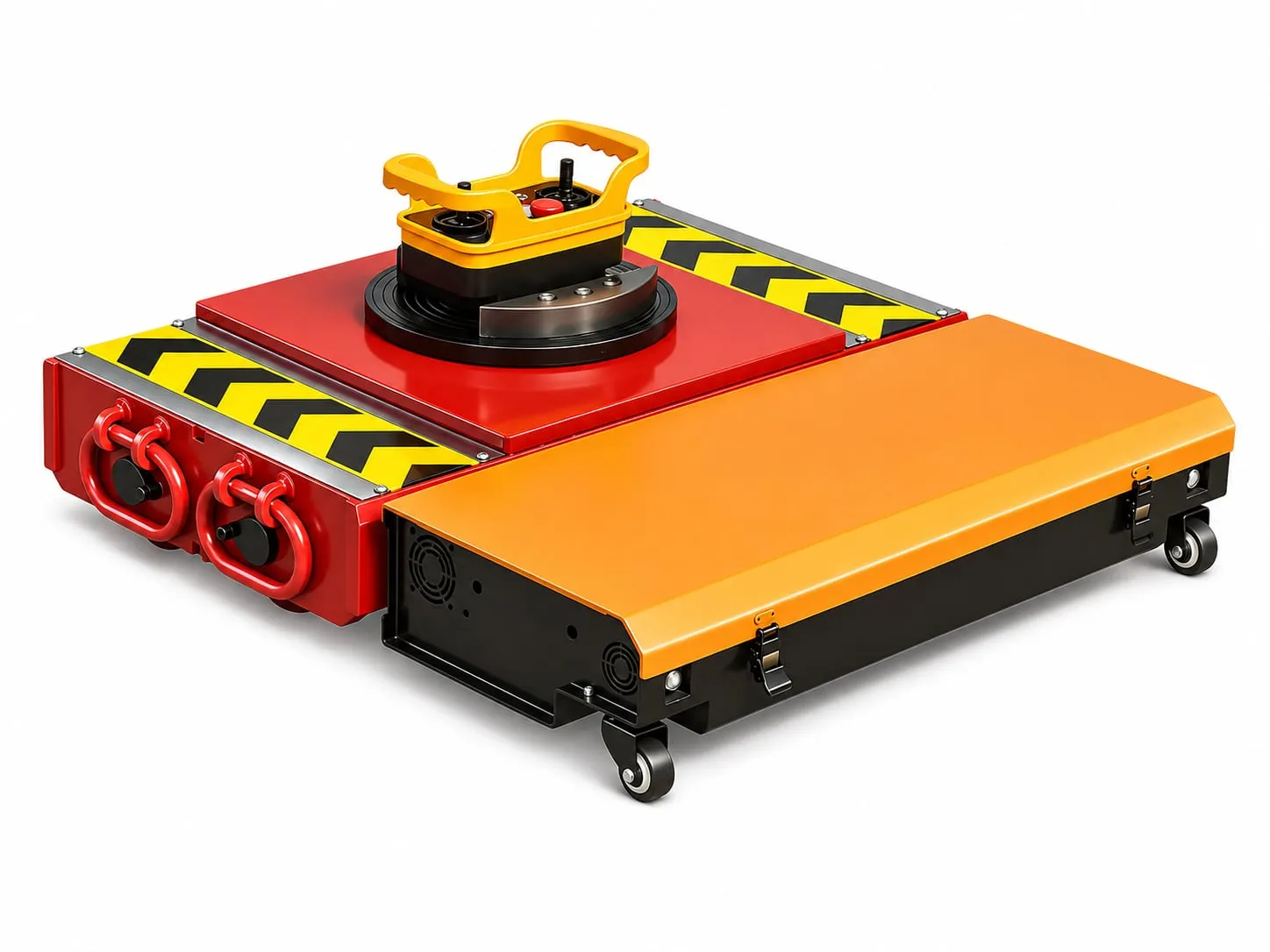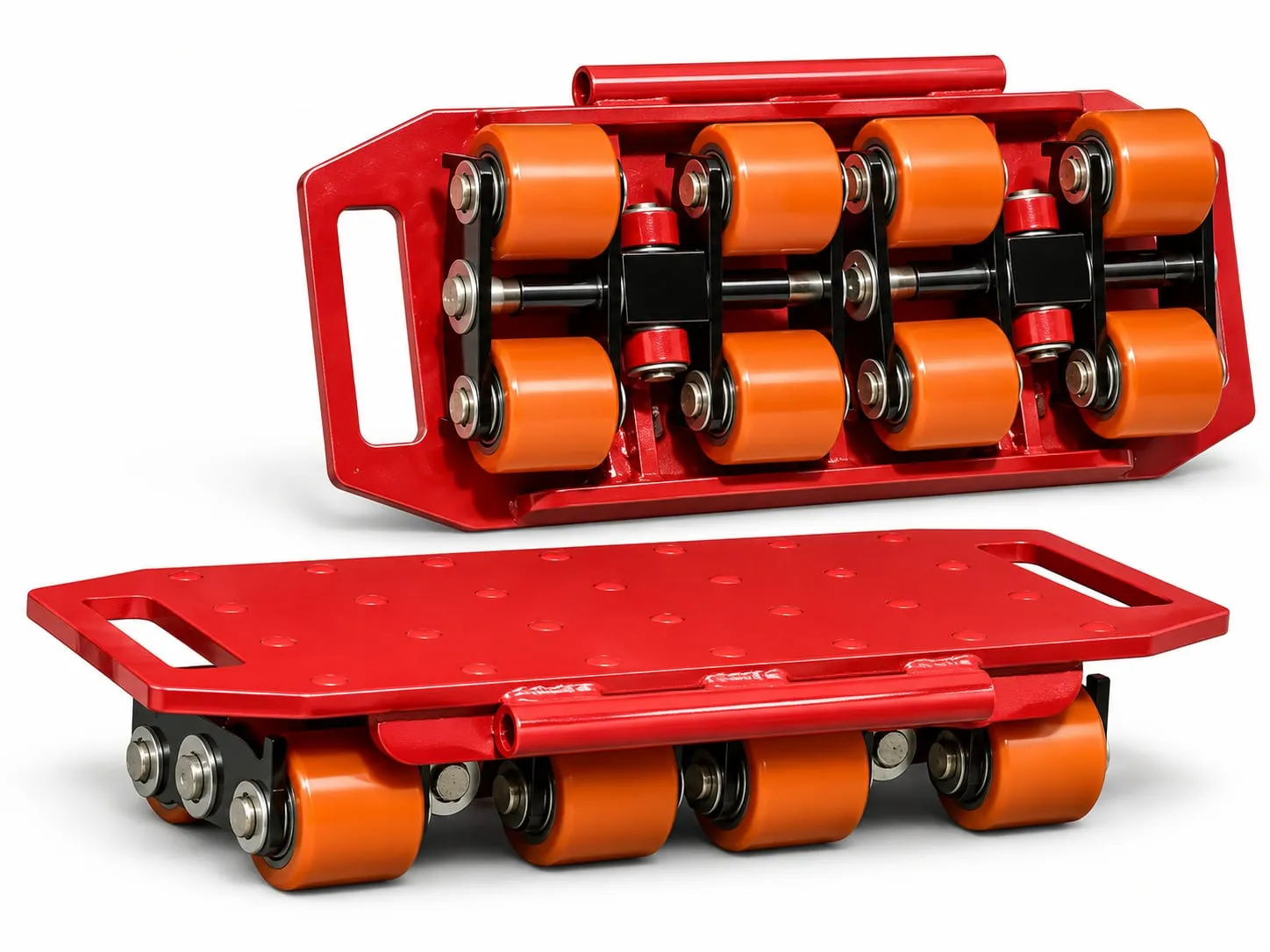
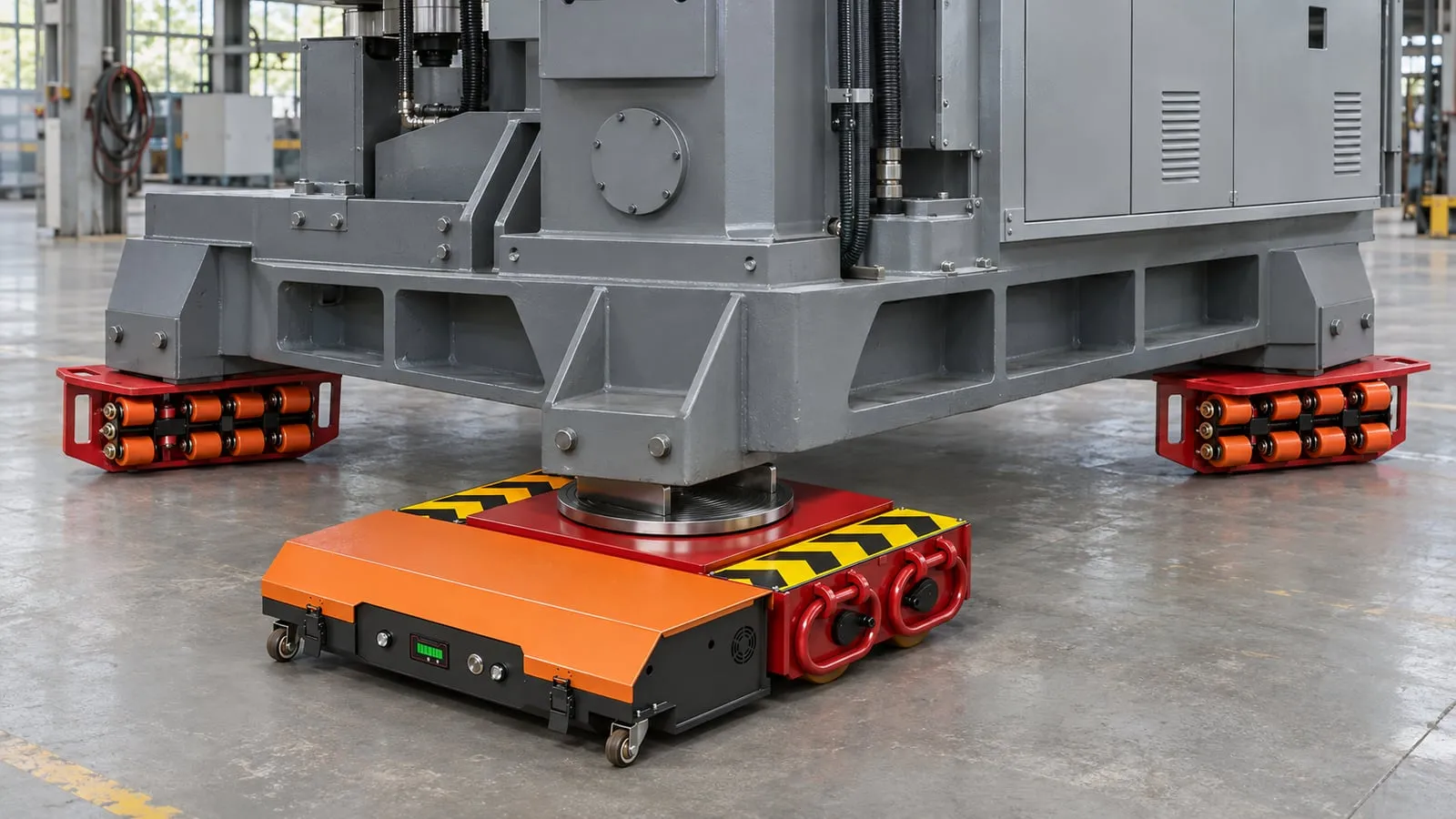
Short answer: Size an electric tank mover set by the load on each end, not just the total weight. Find the centre of gravity, work out how much sits on the tank mover end and how much on the auxiliary cargo trolley end, then choose units that carry those loads with headroom. On our range the model number (TM-10 to TM-60) is what the whole set moves; the tank mover itself carries half.
Step 1: Get the real weight
Use the nameplate, shipping documents or transport drawing, and add what stays on the machine: oil, tooling, a die or mould. If two sources disagree, use the higher one.
Step 2: Find the centre of gravity and split the load
Most machines are not balanced: a press head or motor block puts more weight at one end. The load on each end follows from where the centre of gravity (CoG) sits along the length:
- Load on end A = total weight × (distance from CoG to end B ÷ length)
- Load on end B = total weight − load on end A
Supports under one end also need to be split side to side. Two auxiliary trolleys under a heavy end rarely share the load exactly 50/50, so give each one spare capacity.
Step 3: Match the units
Each tank mover carries half its model rating: TM-20 carries 10 t, TM-25 12.5 t, TM-30 15 t, TM-40 20 t, TM-50 25 t and TM-60 30 t. Auxiliary cargo trolleys are rated per trolley:
| Auxiliary trolley | Load per trolley | Usual set range |
|---|---|---|
| Mini 6-roller (2 rows) | 5 t | 10 t |
| 3-roller (1 row) | 9 t | 10–25 t |
| 4-roller (2 rows) | 12 t | 10–30 t |
| 6-roller (2 rows) | 18 t | 10–30 t |
| 8-roller (2 rows) | 24 t | 30–60 t |
| 10-roller (2 rows) | 30 t | 30–60 t |
| 12-roller (3 rows) | 36 t | 30–60 t |
| 20-roller (4 rows) | 60 t | 60–100 t |
Leave headroom on every unit. As Hilman advises for roller kits, pick the next size up if you are between sizes or unsure of the floor.
Worked example: a 26 t press
Example (illustrative numbers, not a real job): a press weighs 26 t. Its centre of gravity is 40 % of the length from end A.
- End A, closer to the CoG, carries 26 × 0.60 = 15.6 t.
- End B carries 26 × 0.40 = 10.4 t.
- Tank mover under end B: a TM-25 (12.5 t) would leave only about 2 t spare, and its 25 t set rating is below 26 t. A TM-30 (15 t on the mover, 30 t set) carries 10.4 t with about 4.6 t to spare.
- Auxiliary trolleys under end A: 15.6 t shared by two trolleys is 7.8 t each if the split is even. Allowing for an uneven side-to-side split, two 6-roller trolleys (18 t each) give clear headroom; 4-roller trolleys (12 t) would work only if you are sure of the split.
- Note the orientation: turned the other way, the TM-30 would see 15.6 t, above its 15 t limit. Where the tank mover goes matters as much as which model you buy.
Starting points by load
This table assumes the centre of gravity is near the middle and a normal concrete floor. Off-centre loads need the end-by-end check above.
| Total load | Typical set | Auxiliary trolleys (×2) |
|---|---|---|
| Up to about 8 t | TM-10 + 2 trolleys | Mini 6-roller or 3-roller |
| 8–17 t | TM-20 + 2 trolleys | 3-roller or 4-roller |
| 17–22 t | TM-25 + 2 trolleys | 4-roller or 6-roller |
| 22–27 t | TM-30 + 2 trolleys | 6-roller |
| 27–36 t | TM-40 + 2 trolleys | 6-roller or 8-roller |
| 36–45 t | TM-50 + 2 trolleys | 8-roller or 10-roller |
| 45–55 t | TM-60 + 2 trolleys | 10-roller or 12-roller |
| Long, off-centre or heavier | 2 + 2, or 4 synchronised | 12-roller or 20-roller |
1 + 2, 2 + 2 or 4 synchronised?
- 1 tank mover + 2 auxiliary trolleys (three-point support) covers about nine jobs in ten. Three points stay stable on a floor that is not perfectly flat (roller makers such as Hilman use the same 3-point layout), and the tank mover steers the load on its 360° turntable.
- 2 tank movers + 2 auxiliary trolleys suits long loads and loads with an off-centre CoG, where one powered end is not enough.
- 4 tank movers synchronised on one industrial remote move a load sideways, for example along a narrow aisle. Size each mover for its corner share.
Step 4: Check footprint, lifting points and route
- Contact points: the Ø290 mm turntable and the trolley tops need a flat, strong area on the base or a cross-beam. Thin sheet-metal covers are not a support point.
- Height: tank movers are 145–185 mm high. You need jacking points to raise the load enough to slide the units underneath; see how to move heavy machinery with tank movers.
- Floor: polyurethane wheels need a firm, even floor. Check trench covers, expansion joints and suspended floors along the route.
- Slopes and doors: measure every ramp and door width. Factory guidance allows slopes up to about 15°; check slopes with us.
The UK HSE expects lifting operations to be planned by competent people; treat the jacking stage the same way.
What to send us
Send the weight, CoG or a drawing, footprint, lifting points and route photos. We reply with a set from our tank mover range and auxiliary trolleys. For budget planning see the price and buying guide; if you are choosing between methods, read tank movers vs forklifts, cranes and rollers. Or contact us.