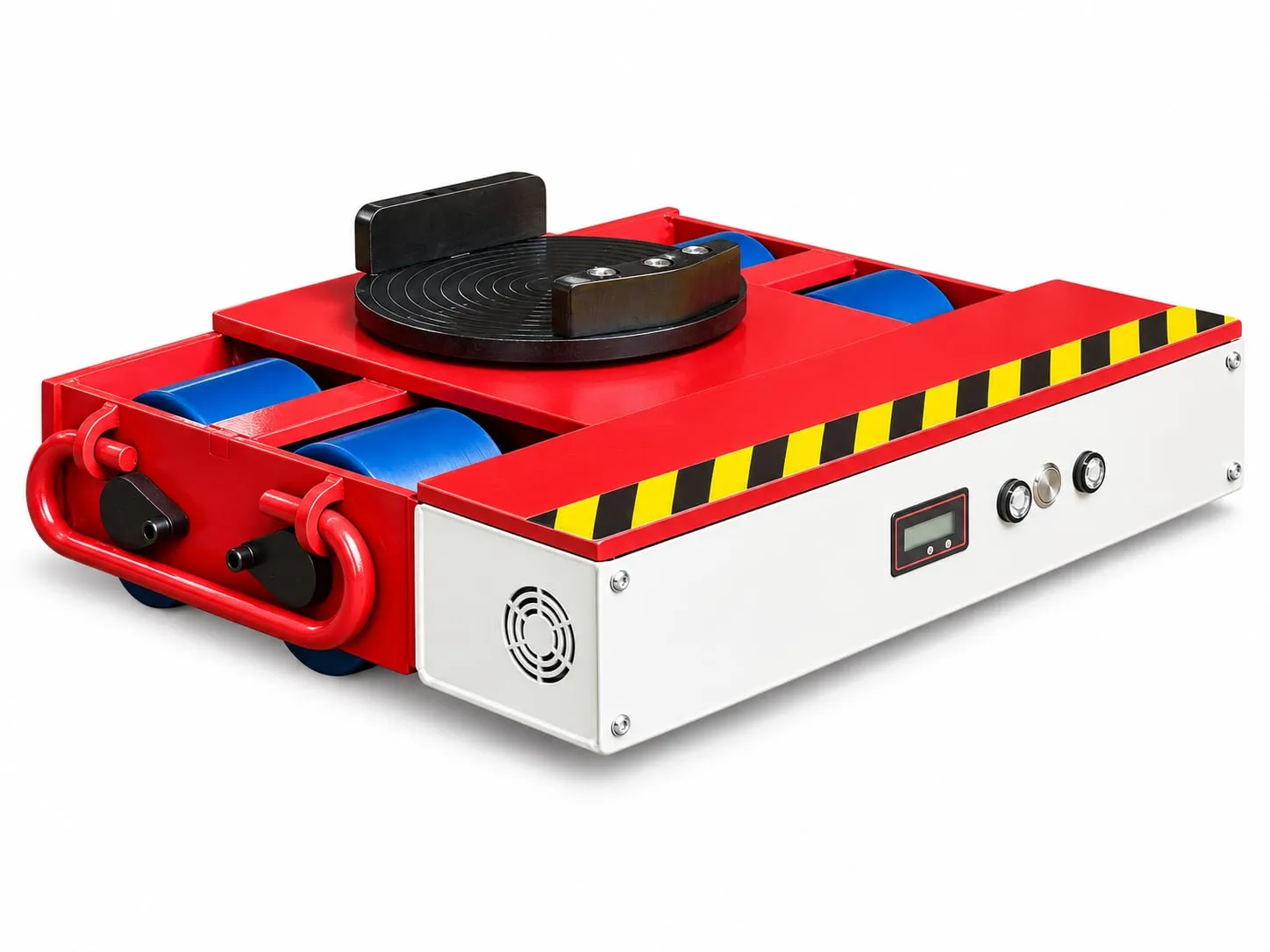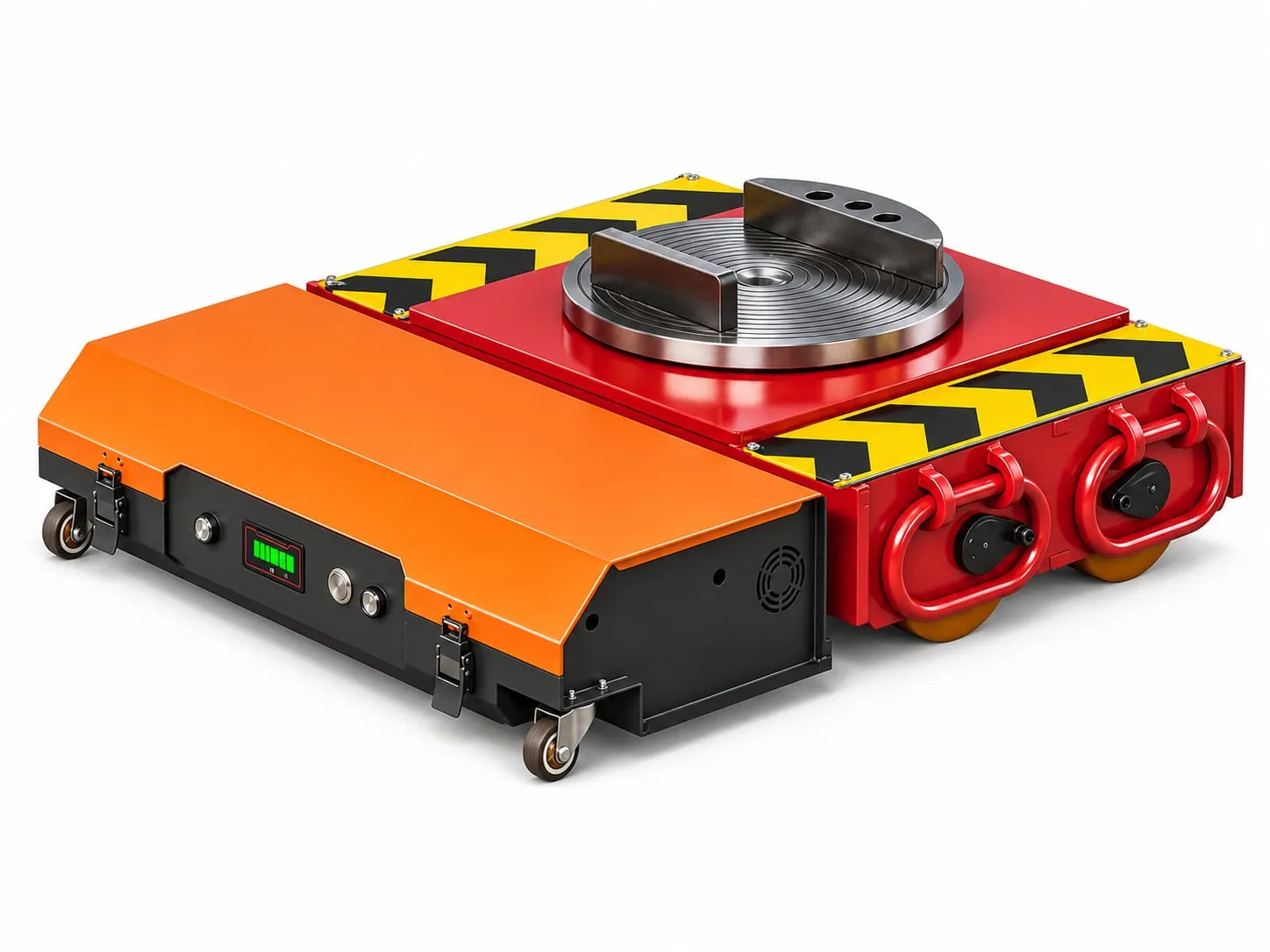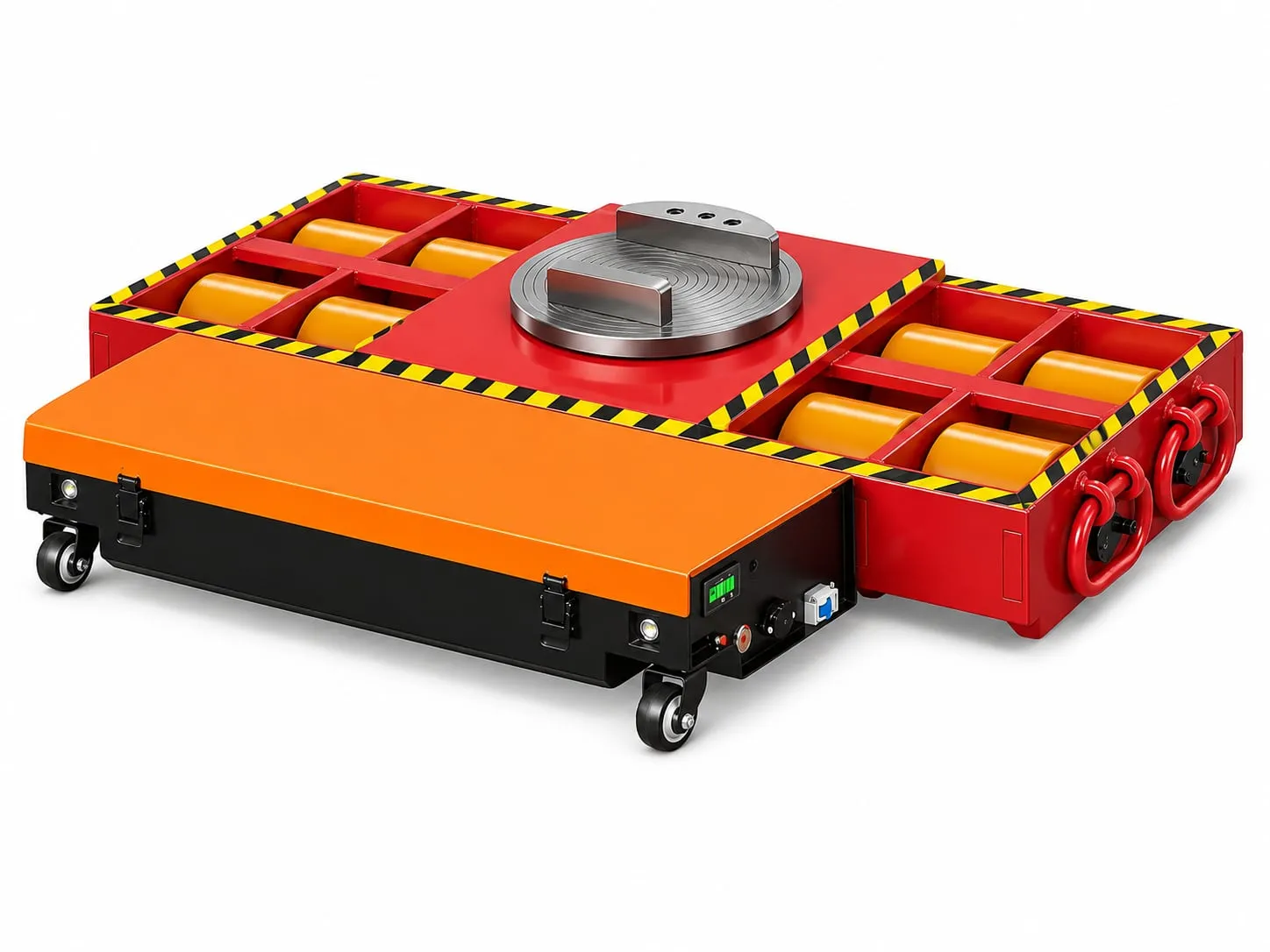
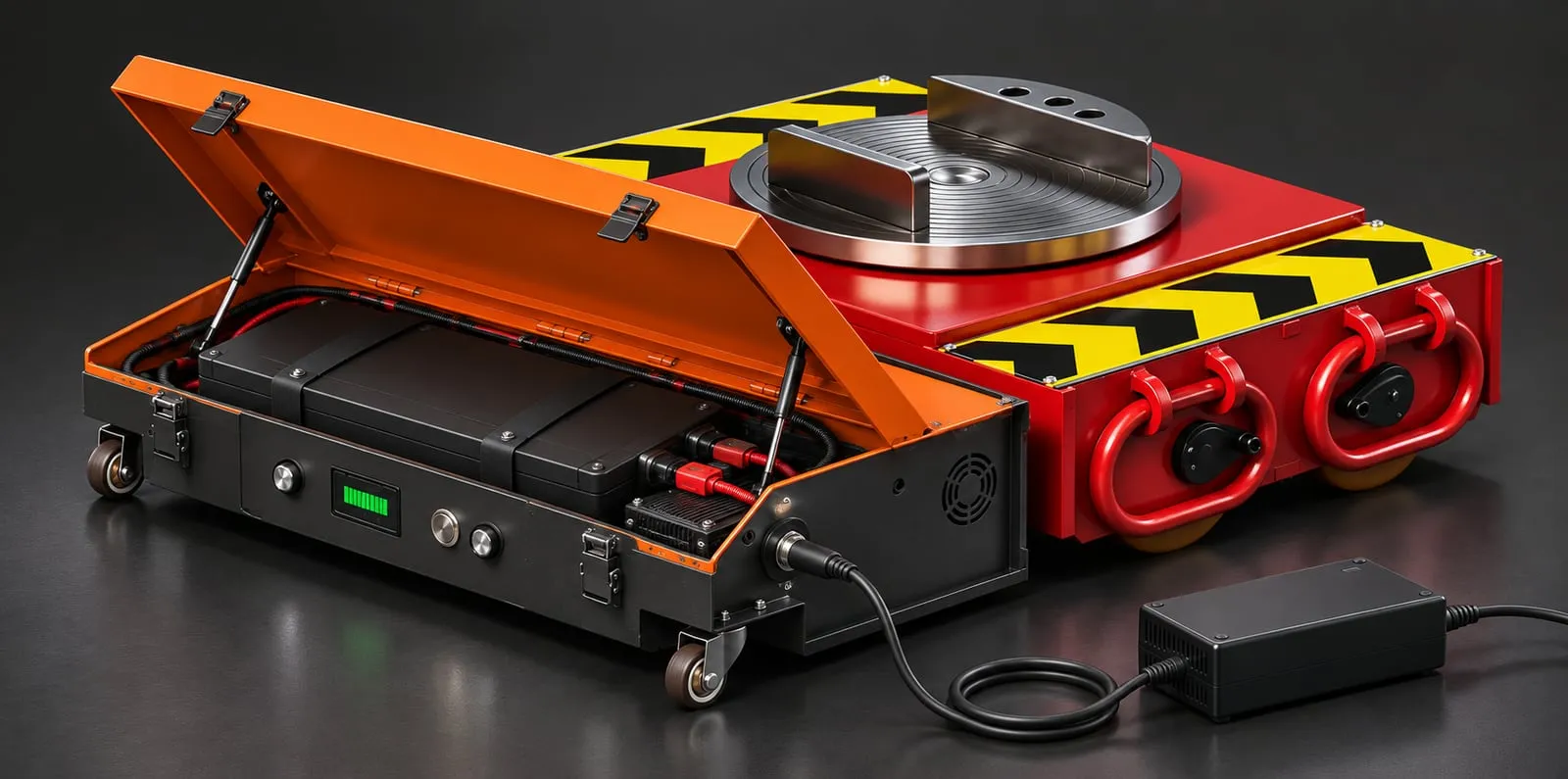
Short answer: An electric tank mover battery is a 48 V lithium pack that gives 2–5 hours of continuous driving, depending on the model. A machinery move only drives for minutes at a time, so one charge normally lasts a working day. Choose NCM for the lightest pack or LiFePO₄ for long cycle life. For export, make sure the supplier provides the UN38.3 test summary and the MSDS.
What the rated run time means
Spec-sheet run time is continuous driving on a full charge. On a real job the motors are off while you jack the load, place the units and check the route.
| Model | Battery | Continuous run time |
|---|---|---|
| TM-10 | 48 V 30 Ah, NCM | 2–3 h |
| TM-20 / TM-25 / TM-30 | 48 V 60 Ah, NCM or LiFePO₄ | 3–4 h |
| TM-40 / TM-50 | 48 V 120 Ah, NCM or LiFePO₄ | 4–5 h |
| TM-60 | 48 V 120 Ah, NCM | 4–5 h |
Travel speed is 2–10 m/min. Even at the slowest setting, 3 hours of driving covers about 360 m. Most moves inside a plant are much shorter than that.
Battery energy: the arithmetic
Energy in watt-hours is volts × amp-hours. It sets how much work the pack can do and which shipping rules apply.
Example (nominal figures, rounded):
- TM-10: 48 V × 30 Ah = 1,440 Wh ≈ 1.4 kWh
- TM-30: 48 V × 60 Ah = 2,880 Wh ≈ 2.9 kWh
- TM-60: 48 V × 120 Ah = 5,760 Wh ≈ 5.8 kWh
- If a TM-30 empties its pack in 3.5 h of non-stop driving, the average draw is about 2.9 ÷ 3.5 ≈ 0.8 kW. Uphill runs, heavy loads and frequent starts draw more; slow, level runs draw less.
All three packs are far above 100 Wh. For air transport, that makes them fully regulated dangerous goods (see below).
NCM or LiFePO₄?
The TM-20, TM-25, TM-30, TM-40 and TM-50 can be supplied with either chemistry. Typical figures from Battery University’s comparison:
| NCM (NMC) | LiFePO₄ (LFP) | |
|---|---|---|
| Nominal cell voltage | 3.6–3.7 V | 3.2–3.3 V |
| Specific energy | 150–220 Wh/kg | 90–120 Wh/kg |
| Cycle life | 1,000–2,000 | 2,000 and higher |
| Typical thermal runaway | about 210 °C | about 270 °C |
| Best for | Lightest pack, occasional use | Daily cycling, long service life, hot sites |
Cycle life depends on depth of discharge and temperature. An LiFePO₄ pack is heavier for the same energy, but on a steel mover that ships in a 102–312 kg crate this rarely matters. Fleets that cycle packs daily gain more from the longer life.
Charging and daily care
- Use the supplied charger. Our spec sheet lists a 54.6 V lithium charger. If you order LiFePO₄, confirm the charger is set up for that pack, and never swap chargers between chemistries.
- Charge before the pack runs flat. Recharging after each shift avoids a dead mover halfway through a job.
- Do not charge below freezing. Battery University gives 5–45 °C as the fast-charge range for lithium-ion, with reduced current below 5 °C and no charging at freezing temperatures. In winter, store and charge the movers indoors. Expect shorter run times when the pack is cold.
- Store partly charged. For storage longer than a few weeks, lithium-ion keeps its capacity better at around 40–50 % charge in a cool, dry place than at 100 %. Top it up every few months.
- Spare battery packs. For multi-shift work or rental fleets, a second charged pack per mover removes any wait for charging.
Shipping lithium batteries with the equipment
Lithium batteries are dangerous goods in transport. Two UN numbers matter:
- UN 3481: lithium-ion batteries contained in or packed with equipment. A tank mover with its pack installed usually ships under this entry.
- UN 3480: lithium-ion batteries on their own, such as spare packs. The rules for these are stricter.
UN38.3. Every lithium cell and battery design must pass the tests in the UN Manual of Tests and Criteria, sub-section 38.3: altitude, thermal cycling, vibration, shock, external short circuit, impact/crush, overcharge and forced discharge. IATA’s guidance says manufacturers and distributors must make a test summary available, listing the test lab, report number, battery mass, Wh rating and pass/fail results. Our batteries ship with the UN38.3 test report and an MSDS from the battery maker.
Sea freight. The IMO’s IMDG Code governs dangerous goods in packaged form by sea and has been mandatory under SOLAS since 1 January 2004. Your forwarder declares the battery as Class 9, confirms the correct UN entry and packing, and books it with a carrier that accepts it.
Air freight. IATA’s 2026 guidance sets the main limits:
- Standalone lithium-ion batteries (UN 3480) must ship at no more than 30 % state of charge and are not allowed on passenger aircraft without approval.
- From 1 January 2026, batteries packed with equipment must also ship at no more than 30 % charge.
- For batteries contained in equipment, 30 % or less is strongly recommended.
What to ask your supplier
- Cell chemistry, nominal voltage, Ah and Wh rating of each pack.
- The UN38.3 test summary and the MSDS/SDS for that exact battery model.
- The charger model and output voltage, and the charging temperature range.
- Expected cycle life and what the warranty covers.
- Whether spare packs are available and how they are packed for shipping.
For help choosing a model, see how to size an electric tank mover set and the price and buying guide. If you are building a rental fleet, read starting a machinery moving rental fleet. For battery documents, contact us.